Why Leadership Time Management Matters
There’s a moment most leaders will recognise. It’s 4:27pm on a Tuesday. You’ve been in back-to-back meetings since 8am. Your inbox has 63 unread messages. One of your direct reports has been waiting three days for feedback on a piece of work that matters to them. You’ve got a steering committee pack due by COB. And somewhere, buried in your calendar for 4:30pm, is a one-on-one you’ve already rescheduled twice.
You cancel it again. You tell yourself you’ll make it up next week.
This isn’t a failure of character. It’s the reality of leadership — and if anyone tells you otherwise, they’ve probably never led anything particularly demanding. But it is worth noting for what it is: a leadership time management decision. Not a neutral default. A choice. And choices, unlike constraints, can be made differently.
Now imagine a different version of that same Tuesday. Same inbox. Same steering committee pack. But this time, the one-on-one happens. It’s twenty minutes, not an hour. Your direct report leaves the conversation with clarity on their work, a piece of honest feedback, and the quiet confidence that comes from knowing their manager actually sees them.
Nothing structural changed. The pressure didn’t ease. But a choice was made differently.
That gap — between the Tuesday where the conversation gets cancelled and the one where it doesn’t — is where leadership actually lives. And it is, at its core, a leadership time management problem: not how much time you have, but what you do with it.
When we were called out
Recently, a program participant pushed back on us. We were talking about creating time for leadership activities — coaching conversations, feedback, visible presence — and they stopped us.
“That’s easy to say. You don’t understand how hard it is to actually find the time.”
They weren’t wrong to push. The frustration was real, and it deserved a real response rather than a reframe. Leadership time management advice that ignores genuine operational pressure isn’t advice — it’s a lecture.
Interestingly, earlier in the session, they and others highlighted that the best leaders they’d ever worked for somehow managed it. The leaders who made them feel seen, developed, and motivated. Those leaders found the time. Not always. Not perfectly. But consistently enough to make a difference.
So the question isn’t whether it’s hard. It is. The question is what separates the leaders who navigate that hardness well from those who get consumed by it. And in our experience, the answer usually comes back to how they think about, and practise, leadership time management — not as a productivity exercise, but as an expression of what they believe their job actually is.
The tension is permanent
We introduce skills, models and frameworks — delegation, feedback, leadership shadow, thinking styles, time management — because we know they turn the dial in making leaders more effective. We don’t do this because they make leadership easy. We know that nothing makes leadership easy.
The tension you feel between operational demands and leading your people is not a problem to be solved. It’s a condition to be managed. Permanently. For the duration of your leadership tenure.
That’s not a counsel of despair. It’s an honest starting point, and in our experience, leaders who accept this stop waiting for the pressure to ease before they start leading well. The pressure doesn’t ease. The organisations that need great leadership most are usually the ones generating the most noise. Treating leadership time management as a temporary challenge — something you’ll get to once the current crisis settles — is a reliable way to never get to it at all.
The frameworks matter because they create capacity. Better delegation means fewer problems land back on your desk. Better feedback means performance issues get addressed early rather than becoming crises. Better self-awareness means you’re less likely to be the source of the dysfunction you’re trying to manage. But none of that happens automatically, and none of it removes the fundamental challenge: you are always choosing between competing demands, and some of those choices are genuinely hard.
The uncomfortable data
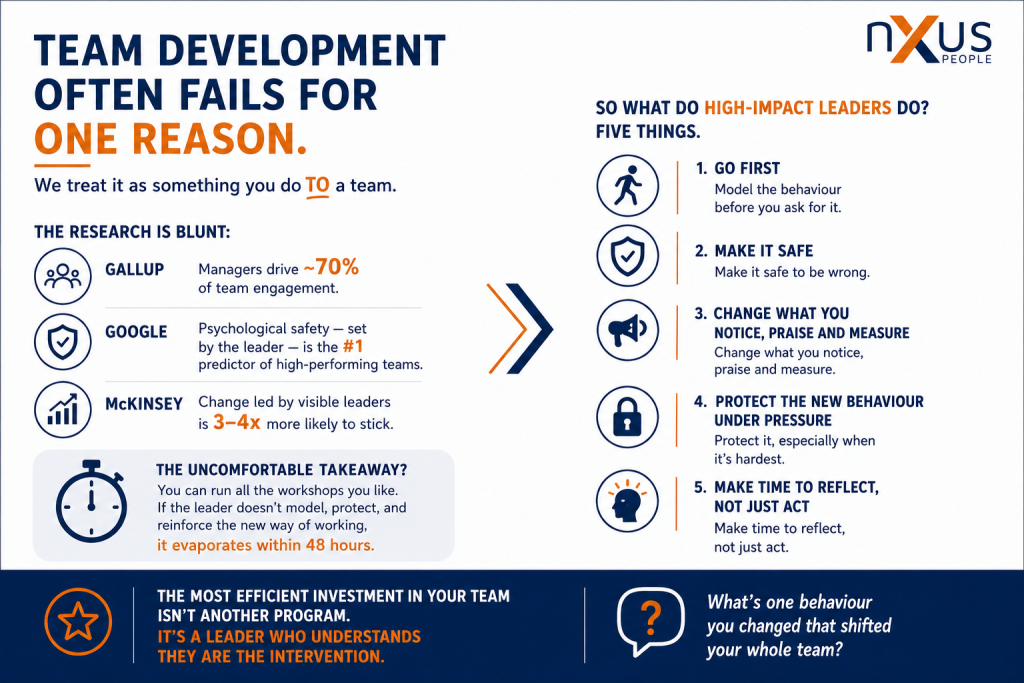
A McKinsey study found that managers spend, on average, less than a third of their time on activities that directly develop or engage their people. Most goes to administration, meetings, and reactive problem-solving. Whatever leaders believe about their priorities, the calendar tells a different story.
Gallup’s long-running research on employee engagement consistently finds that the single biggest variable in whether someone is engaged at work is their direct manager. Not pay. Not culture. Not strategy. Not the organisation’s purpose statement. Their manager — specifically, whether their manager gives them regular attention, honest feedback, and a sense that their development matters.
And yet leadership time management — or more precisely, the absence of it — remains the number one reason leaders give for not investing in their people.
The paradox is almost cruel: the thing that would most reduce your operational load — having capable, motivated, self-directing people who don’t need constant management — requires an upfront investment of time you feel you don’t have. It’s the organisational equivalent of not having time to sharpen the axe because you’re too busy chopping wood.
This is why the framing matters. When leadership time management is understood as an investment rather than an expenditure, the calculation shifts. You’re not spending time on a one-on-one instead of the steering committee pack. You’re investing time in a person who, if developed well, will eventually reduce the number of steering committee problems that need your attention at all.
Great leaders aren’t time wizards
Here’s a myth worth busting: great leaders don’t have more time than you. They face the same structural pressures, the same organisational drag, the same relentless inbox. Senior roles don’t come with more hours in the day — if anything, the demands scale faster than the support does.
What great leaders tend to do differently is make a different set of choices about what gets their time and attention — and they make those choices with a kind of deliberate discomfort. Their leadership time management isn’t accidental. It’s the result of having decided, often explicitly, that certain things — the one-on-one, the direct feedback, the visible presence in moments that matter — are non-negotiable, even when everything else is competing.
They protect the one-on-one even when it’s inconvenient. They give the feedback even when it would be easier to let it slide. They show up to the team meeting present, not half-distracted by the email they could be writing instead.
They’ve also usually made peace with the fact that being a good leader means some other things won’t get done as well as they’d like. The inbox won’t always be at zero. The report won’t always be as polished as it could be. There is a cost to leadership done well, and pretending otherwise doesn’t serve anyone.
Do even great leaders get it wrong? Constantly. Cancel the wrong meeting. Miss the signal that someone’s struggling. Let a difficult conversation drift another week. But the gap between good leaders and great ones is often less about knowledge — most leaders know what they should be doing — and more about the sustained willingness to sit with the tension. To choose the harder thing when the easier thing is right there.
What actually shifts leadership time management
Tools matter. Frameworks help. A leader who delegates well genuinely does have more time. A leader who gives clear, timely feedback genuinely does spend less time managing the consequences of avoided conversations. The practical skills are worth developing, and the return on that investment is real.
But in our work with leaders across Defence, Government and industry, we’ve noticed something consistent: the leaders who make the most lasting improvements to their leadership time management don’t do it through calendaring tricks or productivity systems. They do it through a shift in how they understand the job.
When a leader genuinely internalises that their output is no longer what they personally produce, but what their team produces — and that their team’s capacity to produce is directly shaped by the attention, clarity and development that leader provides — the calculus changes. Time spent with people stops feeling like time away from the real work. It becomes the real work.
That reframe doesn’t make the pressure disappear. It doesn’t conjure extra hours. But it does change what gets protected when the diary fills up and something has to give.
It also changes how you recover when you get it wrong. Because you will. The leader who cancelled the one-on-one twice in a row and finally made it happen on the third attempt is still providing better leadership than the one who stopped trying to schedule it at all. Leadership time management, like leadership itself, is not a state you achieve. It’s a practice you keep returning to.
So what do we actually do with this?
If you’re reading this and nodding, you probably already know what better looks like. You know which conversations you’ve been deferring. You know which of your people are waiting on something from you. You know, somewhere, that the pattern of cancellations is adding up to something — a relationship eroded, a performance issue left to fester, a person quietly deciding their development isn’t a priority here.
The real work beneath all of it is the ongoing negotiation between who you need to be as a leader and what your organisation demands of you on any given day. That negotiation doesn’t end. It just gets more familiar.
The best leaders we encounter aren’t the ones who found the answer to leadership time management. They’re the ones who stayed in the fight with the question — who kept asking themselves whether they were making the right choices, even when they weren’t sure of the answer.
If you’re feeling the pressure of that tension right now, you’re probably more self-aware than you give yourself credit for. The leaders who worry about whether they’re spending enough time with their people are rarely the ones we’d point to as the problem.
The ones who stopped worrying — that’s usually when the trouble starts..
nXus People works with leaders across Defence, Government and industry to build the practical capability that makes the difference.
Want insights into how well your team is set up for success? Take this 3 min quiz for instant analysis. https://nxuspeople.outgrow.us/nxuspeople-2
What is leadership capability? Read more in this nXus People article.