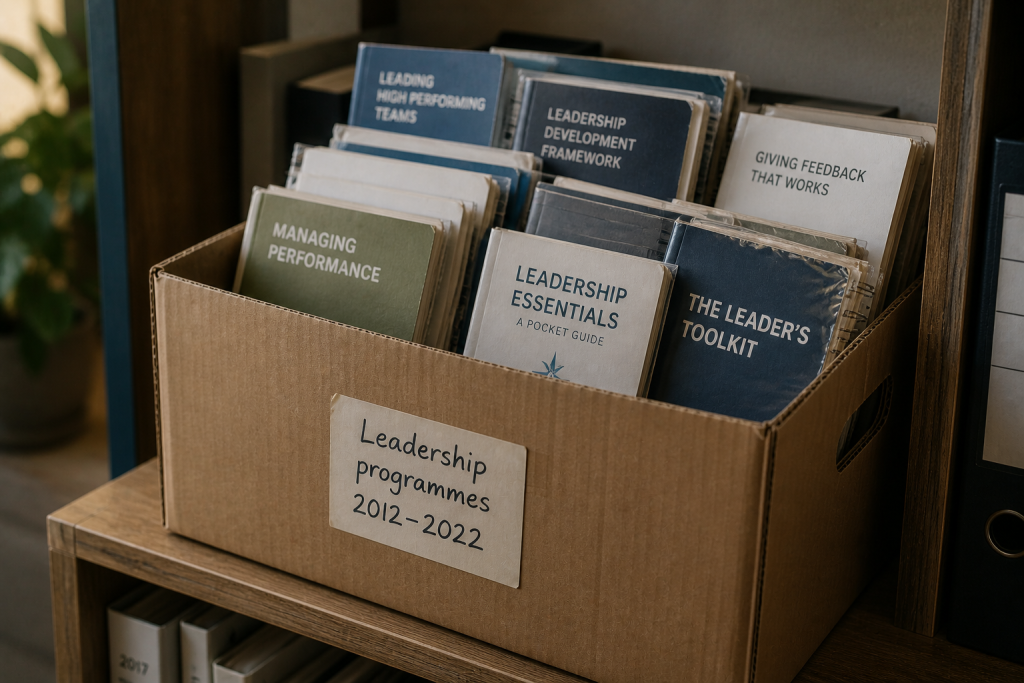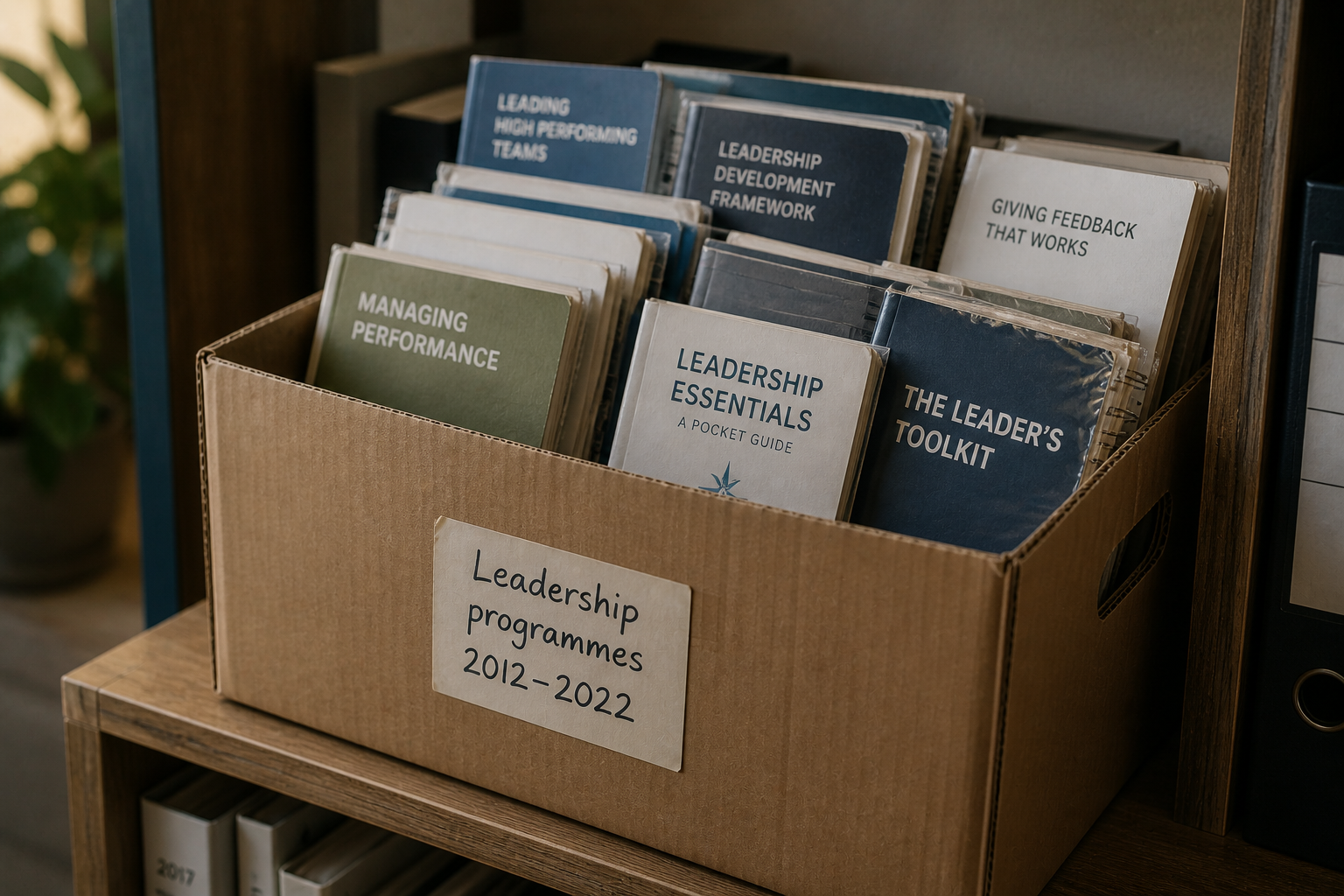
Leadership development programmes fail more often than organisations like to admit — and almost never for the reasons they assume. I was clearing out a storage shelf recently when I came across a box. Inside it — neatly stacked, some still in their original plastic wrap — were leadership development leaflets, toolkits and pocket guides collected across more than a decade in corporate life.
Some of it was genuinely good. Thoughtful frameworks. Solid science. Real effort from the people who put it together. Models for giving feedback, tools for having difficult conversations, and guides on building psychologically safe teams.
Almost none of it stuck. Not because the programmes were poor — most weren’t. The failure wasn’t in the design or the delivery. It wasn’t the facilitators, the content, or the participants’ willingness in the room. The problem was somewhere else entirely, and most people who’ve worked in or around organisational development know exactly what I’m talking about, even if they don’t always say it out loud.
The Missing Ingredient Isn’t More Training
What I kept coming back to as I flicked through those guides was this: I could remember, with reasonable clarity, which senior leaders had visibly engaged with each initiative after the training finished — and which ones hadn’t. Where the people at the top kept talking about it, referenced it in how they ran meetings or gave feedback, let it show up in their day-to-day behaviour — it travelled. Where they didn’t, it didn’t.
This is the central challenge of leadership development that doesn’t get enough airtime. Organisations invest significantly in developing their people — workshops, coaching programmes, 360-degree feedback, psychometric assessments — and then wonder why the behaviours don’t shift at scale. The answer, more often than not, is that the development sat in a layer of the organisation without ever being genuinely modelled from the top.
Why Middle-Layer Championing Isn’t Enough
What made the pattern more interesting, looking back, was that in several of those cases the layer below senior leadership genuinely championed the change. Motivated managers who believed in it. They ran follow-up sessions, reinforced the language, tried to keep the momentum going. And it still petered out.
Not because they failed, but because sustainable behaviour change doesn’t take hold through enthusiasm alone. When senior leaders aren’t visibly modelling the behaviours being asked of others, the message people actually receive — regardless of what the toolkit says — is that this isn’t really how we do things here. The initiative goes in a drawer. Eventually, it ends up in a box on a shelf.
Wholistic Behaviour Change: What It Actually Requires
Effective leadership development — the kind that actually shifts how people behave over time — requires the whole system to point in the same direction. That means several things working together rather than in isolation.
Senior leaders need to visibly engage with the same frameworks their teams are working through. This is where adaptive leadership becomes critical — not as a concept to be taught, but as a practice to be demonstrated. Adaptive leaders don’t just manage change from a distance; they personally model the adaptation they’re asking of others. When that’s absent, even the best-designed development programme becomes a layer of activity sitting on top of an unchanged culture. If a leadership programme introduces a model for constructive challenge and senior leaders continue to shut down dissent in the room, the model is dead on arrival.
Recognition and reward structures need to reflect the same values as the development programme. Organisations frequently invest in building collaborative, psychologically safe cultures while simultaneously promoting and rewarding purely individual performance. These signals contradict each other, and people respond to what gets rewarded, not what gets taught.
Development also needs to be continuous rather than episodic. A two-day offsite, however well-designed, does not change behaviour that has been reinforced for years. Leadership coaching, team effectiveness work, and culture change initiatives are most effective when they’re sustained, connected to real work, and revisited over time — not treated as a one-off event after which leaders are left to their own devices.
And critically, the development agenda needs to be owned at the top, not delegated to HR or a learning and development function and then left to run without executive engagement. When senior leaders genuinely own the development agenda — when it’s connected to the organisation’s strategic priorities and treated as business-critical rather than a nice-to-have — it lands differently at every level below.
Culture and Leadership Development Are the Same Problem
None of this is separate from culture. In fact, one of the most reliable indicators of whether a leadership development programme will have lasting impact is the culture it lands in. A culture that genuinely values growth, honest feedback, and continuous improvement will absorb and build on good development work. A culture that tolerates poor leadership behaviour at senior levels, avoids difficult conversations, or rewards compliance over initiative will quietly neutralise even the best programme.
This is why treating culture change and leadership development as separate workstreams is a mistake so many organisations make. They commission a leadership programme here, a culture initiative there, and find that neither delivers what was expected — because they’re working on the symptom without addressing the system. Culture change and leadership development aren’t parallel tracks. They’re the same journey, and they need to be designed that way from the outset.
The Question Worth Asking Before You Commission Anything
Before investing in any leadership development programme, the most important question isn’t “what is the best programme available?” It’s “what needs to be true across our whole organisation for this to actually land?”
That requires an honest look at whether senior leaders are genuinely willing — not just nominally supportive, but personally committed — to model the behaviours being asked of others. It means examining whether the structures, incentives, and cultural norms in place will support or silently undermine the change. And it means going in with the expectation that real behaviour change takes time, repetition, and coherence across the system — not a single intervention, however well-designed.
These are the conversations we have at nXus People before we design anything. Whether we’re working on senior team effectiveness, leadership coaching, culture change, or broader organisation development, we start by understanding the whole system — because that’s where lasting change is either enabled or blocked. The organisations we work with across Defence, Government, and industry face real complexity. They need development that is coherent, connected, and built to stick.
The box of guides went in the recycling. But the question it raised isn’t going anywhere.
How many of your leadership development investments are being championed hard by the right people — just not quite at the right level?
Want to know more about successful leadership programs? Check out this previous post. https://nxuspeople.com.au/2026/04/13/what-makes-a-successful-leadership-development-experience/