Nearly half of Australian workers are burnt out right now.
Not stressed. Not tired. Burnt out — that specific state where the gap between what work demands and what people have left to give has closed completely. Where the meaning has gone out of the effort.
That’s not a wellness problem. That’s a leadership problem.
When Burnout Gets Medicalised, Workplaces Walk Away Clean
The ABC recently published a substantial long read on burnout — who carries it, what it does to the body, and why the way we diagnose and define it has real consequences. The core argument is worth sitting with: when burnout is treated as a medical condition, as something that happens to an individual rather than within a system, the organisation is absolved.
The worker pays — in leave, in therapy, in lost income, sometimes in a career that quietly contracts while they recover. The workplace continues unchanged.
This framing matters enormously. It determines whether we reach for a solution or a coping mechanism.
What Organisations Actually Reach For (and Why It’s Not Enough)
At nXus People, we see this pattern constantly across Defence, government, and industry clients. When burnout rates spike, the organisational response is usually some version of the same playbook:
- Resilience training workshops
- Mindfulness programmes
- Mental health apps and EAP reminders
- R U OK? Day activations
- Wellbeing surveys with no visible follow-through
None of these are worthless. Mindfulness practices have genuine value. Psychological first aid matters. But if the environment is broken, asking people to cope better with something that shouldn’t exist isn’t a solution. It’s the appearance of one.
We call this “sand in the underpants.” The bureaucracy. The inefficiency. The approval chains that add weeks to decisions that should take hours. The friction that accumulates until people lose the thread between their effort and any meaningful outcome. It’s not hard work that burns people out. It’s hard work that feels pointless.
The Real Drivers of Burnout
Research consistently identifies the same root causes. These are not individual factors — they are organisational and leadership ones:
Workload without autonomy. High demands are survivable when people have genuine control over how they meet them. When workload is high and autonomy is low, burnout accelerates.
Values misalignment. When people are asked to act in ways that conflict with what they believe is right — cutting corners, treating people as numbers, tolerating poor behaviour from senior figures — the erosion is invisible at first, then sudden.
Reward disconnection. Not just pay. Recognition, feedback, the sense that contribution is seen and valued.
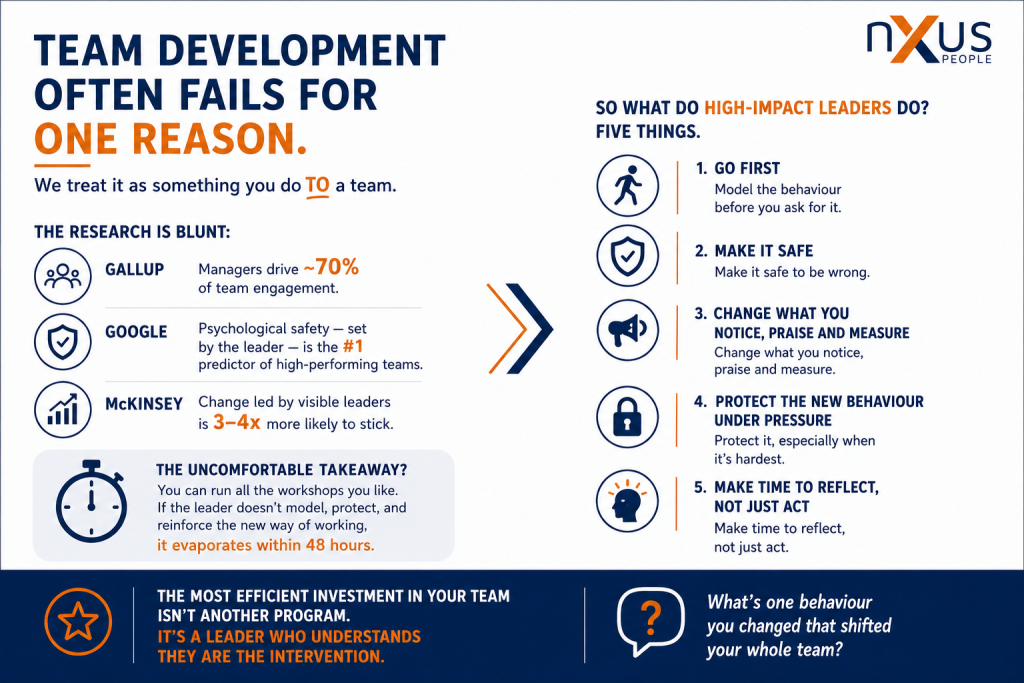
Fairness and psychological safety. Environments where people fear speaking up, where credit flows upward and blame flows down, are environments where trust is constantly being depleted.
Absence of belonging. Isolation — particularly acute in hybrid and distributed teams — strips work of one of its most sustaining dimensions.
These aren’t addressable by a meditation app. They require leadership attention, structural change, and the willingness to examine what the culture actually rewards versus what it claims to value.
The Business Case Is Unambiguous
Gallup’s research estimates the global cost of low engagement and burnout at $8.9 trillion annually. In Australian terms, disengaged employees cost the economy an estimated $211 billion per year in lost productivity.
The organisations we work with that invest in addressing root causes — culture, workload design, leadership behaviour, genuine autonomy — don’t just have healthier people. They perform better. They retain better. They attract better. The business case for taking burnout seriously as a structural issue, not a personal one, is not close.
The Equity Problem
There’s a dimension to this that doesn’t get discussed enough in leadership circles: individual solutions to a systemic problem are only accessible to those with the financial and structural resources to act on them.
The executive who can take three months of sabbatical, work with a coach, redesign their schedule, and return refreshed is not the same person as the mid-level public sector worker carrying a caseload that hasn’t been reviewed in four years. Or the defence contractor whose security clearance depends on appearing fine. Or the early-career professional who can’t afford to be seen as difficult.
When we treat burnout as something individuals must manage, we entrench inequality. Those with the least systemic power carry the most systemic cost.
This is why systemic change isn’t a nice-to-have. It’s an equity issue with a direct line to organisational performance.
What Senior Leaders Should Be Asking
The question isn’t whether your people are resilient enough.
The better questions are:
- Does the way work is designed here make it possible to do good work?
- Do our managers have the capability and the permission to protect their teams from unnecessary load?
- Is psychological safety real in this organisation, or is it a value we mention in induction?
- When someone tells us they’re struggling, does the system protect them or expose them?
- Are we rewarding outputs that come at the cost of people?
These are uncomfortable questions. They’re also the right ones.
If your organisation is investing in wellbeing programmes without examining leadership behaviour, workload design, and cultural norms — you’re not solving the problem. You’re managing the optics of it.
For Individuals in Organisations That Won’t Change
Sometimes the system won’t move. Leaders who see the problem clearly but don’t control the environment it sits in face a genuinely difficult position.
If that’s you: don’t make the mistake of underestimating your value to organisations that will do things differently. The market for psychologically safe, high-autonomy, purpose-driven workplaces is growing — because the evidence for their performance advantage is now too large to dismiss.
Your resilience has value. Make sure you’re directing it somewhere that deserves it.
How nXus People Can Help
nXus People works with senior teams and organisations across Defence, government, and industry to address the leadership and cultural conditions that drive burnout — before it reaches crisis point.
Our work includes:
- Senior team effectiveness — diagnosing the patterns, dynamics, and behavioural norms that accumulate into dysfunctional culture
- Leadership development — building capability in the areas most directly linked to team wellbeing: psychological safety, feedback, workload design, and authentic communication
- Organisational design — reviewing how work is structured, where unnecessary friction lives, and how accountability is distributed
- Leadership assessment and coaching — helping individual leaders understand their own impact and develop the self-awareness to lead differently
Want to Know How Your Team Is Tracking?
Is your team set up to do their best work — or are they carrying friction that shouldn’t be there?
Take our 3-minute Team Effectiveness Quiz for instant, personalised analysis of where your team is thriving and where the risk is building.
What’s your experience — are organisations actually changing, or is it still wellness theatre? We’d like to hear from you.
- Learn more about how we support culture and leadership development here
- Check out the latest research on the benefits of good employee engagement here: Gallup: The Benefits of Employee Engagement
Tags: workplace burnout, employee wellbeing, leadership development, organisational culture, psychological safety, employee engagement, workforce management Australia, burnout prevention, leadership accountability, Defence workforce, government workforce, resilience at work, team effectiveness, nXus People
Internal linking suggestions: