Many of us have enjoyed the experience of a tech rollout like a new ERP or CRM. It comes with a new system, new workflows, and a stack of well-intentioned change management slides. Eighteen months later, half the business is still working around it in Excel. Why? Often it’s because nobody did the harder work of leadership and culture alongside the tech.
It’s not just ERP. CRM platforms, HR information systems, digital transformation programs of every stripe: the pattern repeats often enough that it’s practically a genre. Industry research over the years has put the failure-to-deliver-value rate for major ERP implementations somewhere between half and three-quarters of projects (Godlan, ERP Research). The exact number moves depending on who’s counting and how “failure” is defined, but the direction never does. Buying good technology has reliably not been the hard part.
We’re hearing a lot right now about AI as an unprecedented leadership challenge: urgent, disruptive, without precedent. Some of that is true, and we’ll get to it. But the underlying mechanism isn’t new at all. It’s the same mechanism that’s been quietly derailing technology investments for decades, and it’s worth naming plainly before we talk about what actually is different this time.
The ROI was never really about the technology
Every technology rollout worth doing promises the same thing: better information, faster decisions, less duplicated effort, more capacity for the work that matters. And the return on that promise has never depended mainly on the technology delivering what it says on the box. It has depended on three much harder things happening at the same time.
Leaders genuinely understanding the business problem they’re solving, rather than buying a platform because a competitor has one or a vendor made a compelling pitch.
A business case built well enough that the organisation believes in it, not just a capital approval that clears a governance hurdle.
Strong leadership and deliberate culture change to carry people from the old way of working to the new one, including the people who quietly liked the old way just fine.
Skip any one of those and the technology arrives on schedule and under delivers anyway. This isn’t a controversial insight. Most people who’ve sat through a major systems change already know it in their bones. And yet organisations keep buying the technology and under-investing in the leadership work that makes it land, project after project, decade after decade.
Why we keep getting it wrong
It’s worth asking why, given how well understood this is, we keep repeating it. Part of it is structural: technology has a clear owner, a budget line and a go-live date, while the leadership and culture work is diffuse, harder to schedule, and easy to compress when the project runs late. Part of it is human: it’s more comfortable to manage a Gantt chart than a room full of people who are anxious about their jobs. And part of it is simply that the consequences of skipping the harder work show up slowly, in adoption curves that never quite recover, not in a dramatic failure on launch day.
Whatever the reason, the record is consistent. We are not, as a rule, good at pairing significant technology change with the leadership and culture change it actually requires.
In some ways, it’s great that AI isn’t a new version of this problem
It means we already know what actually works. It’s the same problem, with three differences that make it a lot more urgent.
Firstly, we have far less choice about whether to engage. With most enterprise software, an organisation could reasonably decide a platform wasn’t for them and keep operating much as before. Sitting this one out isn’t really an option in organisations that want to thrive and survive. AI is already inside how your competitors price, staff, sell and serve customers, whether or not you’ve made a deliberate decision about it.
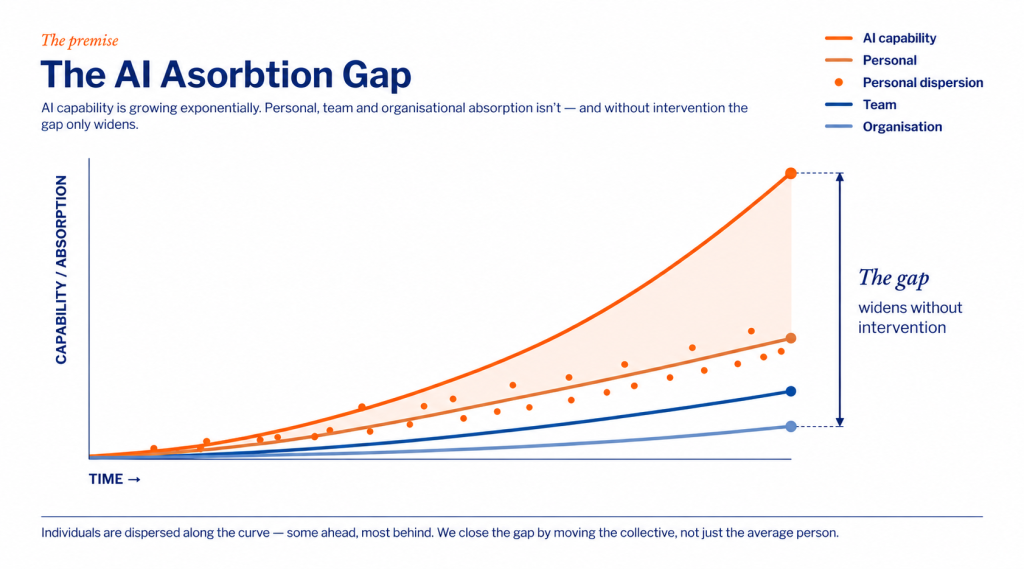
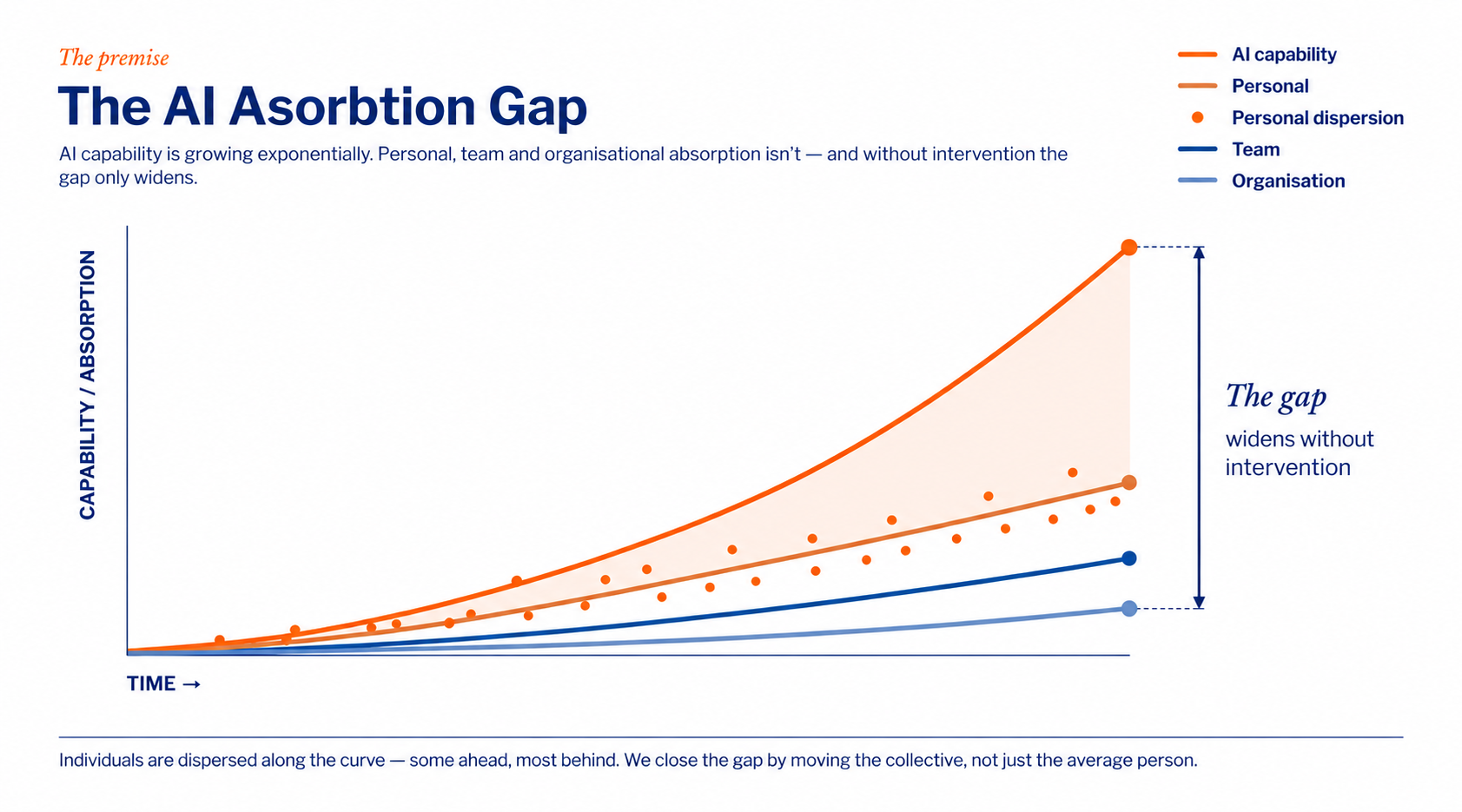
Secondly, it’s moving faster than most organisations can absorb, and it isn’t slowing down to let anyone catch up. This is where AI stops rhyming with past technology change and starts behaving differently. AI capability is growing exponentially. Most organisations’ capacity to absorb and apply it, to actually turn that capability into changed decisions, changed roles and changed ways of working, is not. Left alone, that gap between what AI can do and what your organisation can actually put to work doesn’t hold steady. It widens, year on year, and the widening is the risk, not any single lagging rollout.
Thirdly, there’s no “post go-live” calm to look forward to. This isn’t a project with an end date, it’s a permanent feature of how the business now runs. A typical technology project has an end state: the system goes live, the dust settles, the organisation adjusts and moves on to the next thing. AI capability is not a fixed destination. The leadership and culture work isn’t a project with a finish line, it’s now a standing part of how the organisation has to operate.
Put those three together and the stakes change shape. A poorly led ERP rollout usually means wasted budget and years of workarounds: painful, but survivable. A poorly led response to AI, sustained over the years this shift is going to take, is a much more serious kind of risk. It’s an organisation that keeps doing the old thing well while a widening gap opens up between what’s possible and what it’s actually capable of, and while competitors closing that gap faster pull further ahead.
What this means in practice
None of this means the answer is to panic-buy AI tools, and it isn’t a case for outsourcing the thinking to whichever vendor makes the most confident pitch. If anything, it’s the opposite. The organisations that come through this well will be the ones that do the unfashionable, unglamorous leadership work: understanding the actual business problem, building a case people believe in, and leading people through the change deliberately, and do it at a pace that closes the gap rather than lets it widen.
The challenge hasn’t changed, and the leadership and culture work hasn’t changed. What’s changed is how much more important it is to be better at it, and how deliberately organisations now need to invest in their own capacity to absorb this, not just their access to the technology.
That combination, the discipline of good change leadership applied at AI speed, is exactly what we built AI Leadership Compass to help leaders do. Not a tool rollout. A way for leadership teams to work out where they genuinely stand, what capability they need to build first, and how to bring their people with them, without losing the eighteen months everyone used to be able to afford to lose.
If you’re wrestling with how your own leadership team is approaching this, we’d be glad to compare notes.
A few common questions
Is AI adoption really the same problem as past technology rollouts?
Mechanically, yes — the same three things (understanding the business problem, a business case people believe in, deliberate leadership through the change) determine whether it lands. What’s different is the pace, the lack of an opt-out, and the fact that there’s no post-launch calm to recover in.
What is the “AI absorption gap”?
It’s the widening distance between how fast AI capability is improving and how fast an organisation’s people, teams and structures can actually put that capability to work. Left alone, the gap doesn’t stay level — it grows every year.
How do we start closing it?
The same way any well-led change starts: understand the actual business problem AI is meant to solve, build a case the organisation believes in, and lead people through the change deliberately — at a pace that keeps up with the technology rather than falling further behind it.
Follow us on LinkedIn
Read more of our insights here
Check out our AI strategy partner, The Helix Labs.