There’s a persistent myth in organisational change work — that team development is something you do to a team. Invest in the people. Run the training. Redesign the processes. And if it doesn’t stick? Run it again.
But the research tells a different story. When it comes to genuine team development — shifting how a group behaves, learns, and performs — the leader isn’t just one variable among many. The leader is the variable.
This article explains why effective team development depends more on leadership behaviour than on any single program, what the evidence actually says, and the practical steps leaders can take to multiply the return on every dollar and hour they invest in it.
What Team Development Really Means
Before we examine the evidence, it helps to be precise. Team development is the deliberate, ongoing process of building a group’s collective capability — its trust, communication, shared decision-making, and capacity to learn and adapt together — so the team consistently performs better than the sum of its individuals. Put simply, it is how an ordinary group becomes one of the high-performing teams every organisation wants.
Too often, the term gets reduced to a single calendar event: an offsite, a one-day workshop, a personality profile. Those activities have their place, but durable team development is continuous. It lives in the daily rhythm of how a team works — who speaks in meetings, how mistakes are handled, what gets noticed and rewarded — and that rhythm is set, almost entirely, by the leader.
What the Research Actually Says
The case for putting leaders at the centre of team development is not a matter of opinion. Three decades of organisational research point in the same direction.

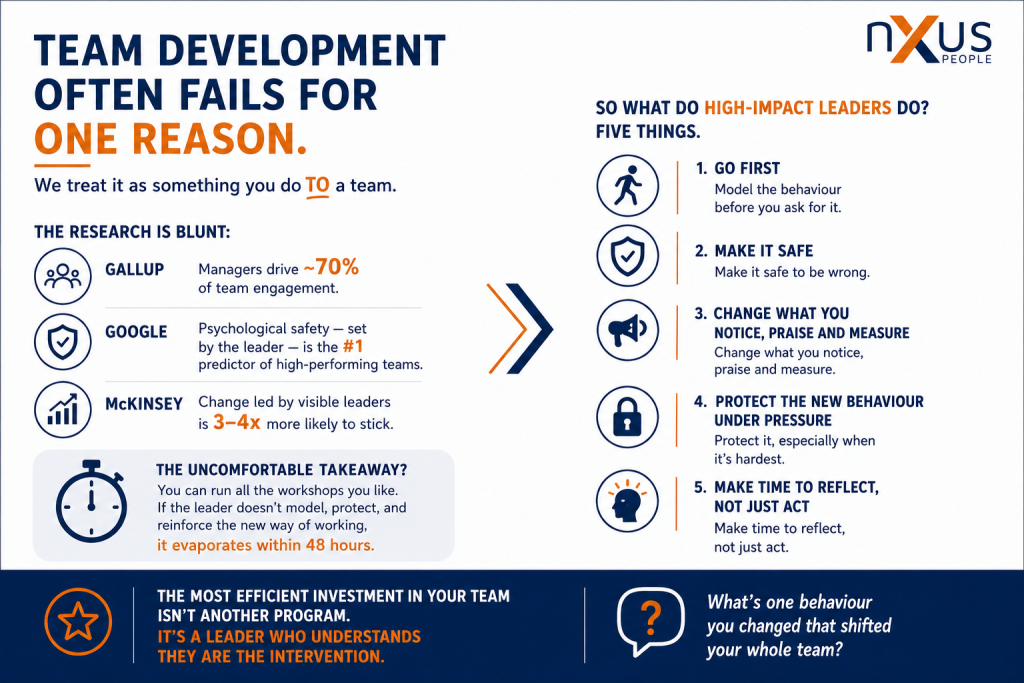
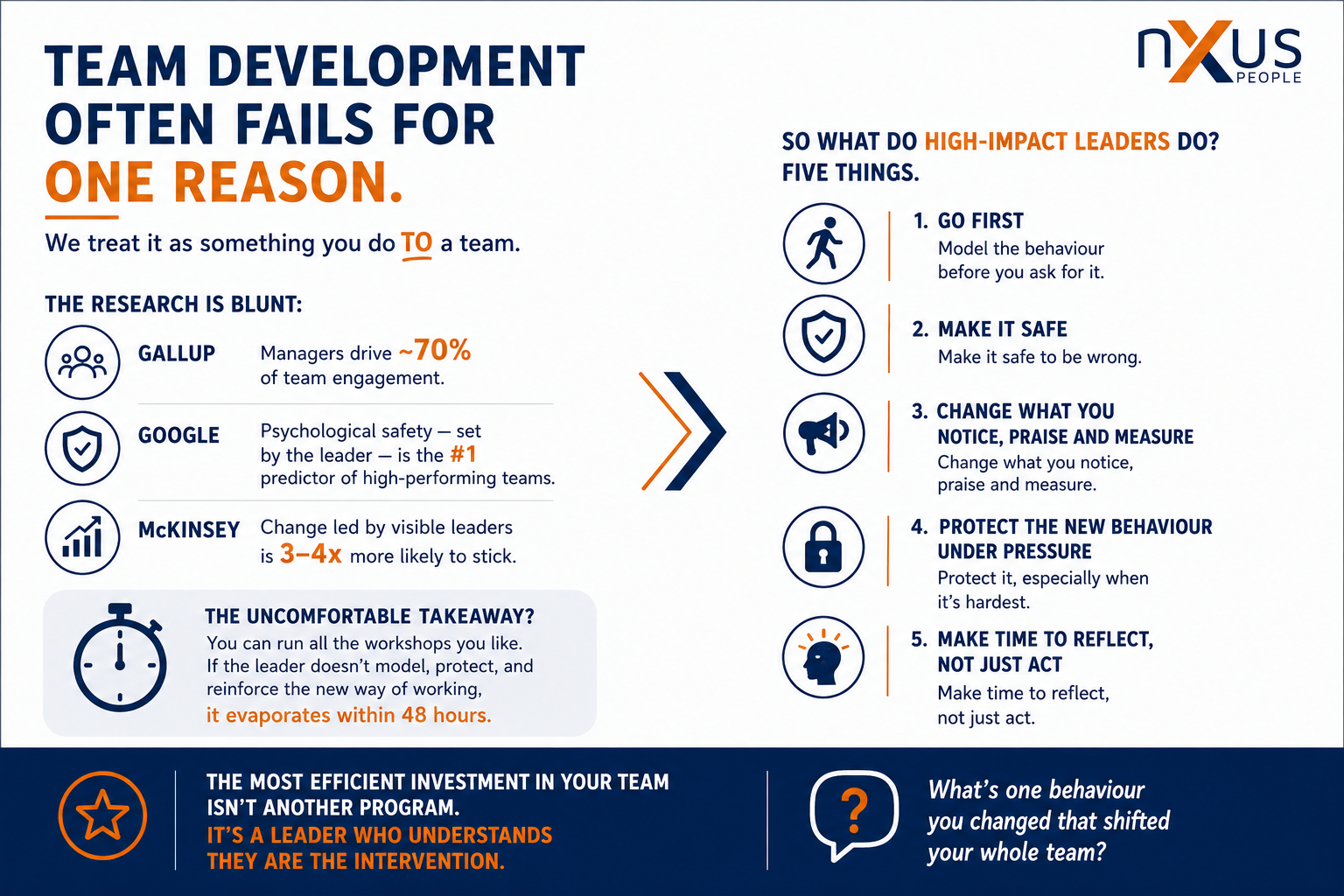
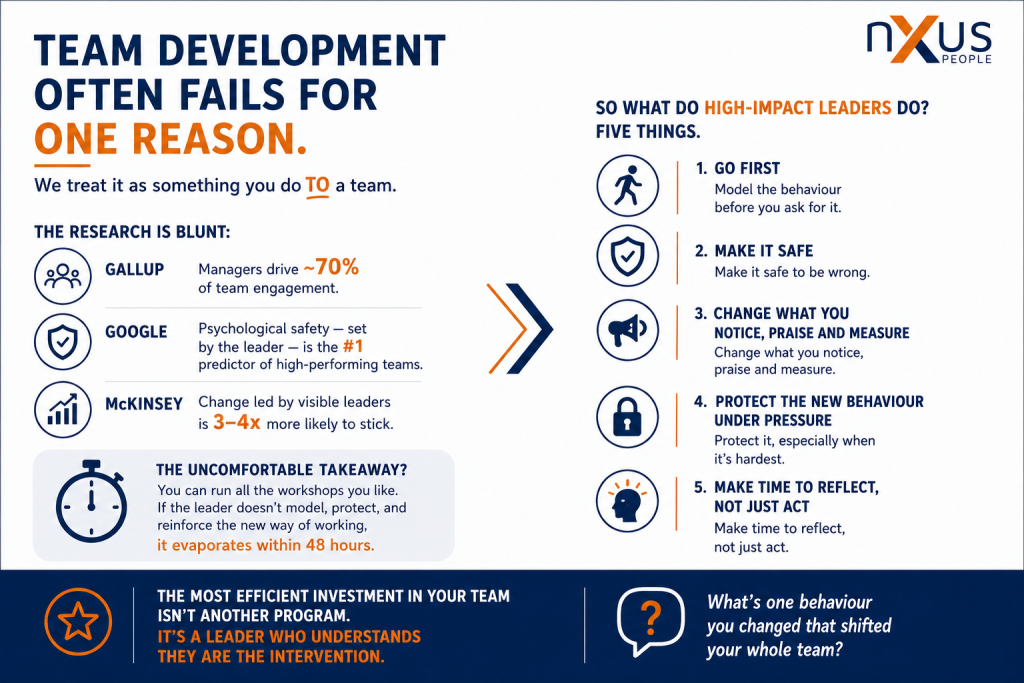
Gallup’s decades of employee engagement data consistently show that the manager accounts for approximately 70% of the variance in team engagement — the single largest factor, dwarfing pay, perks, or organisational culture at large. Engagement is the soil that capability growth depends on, and that soil is cultivated by the leader. Teams don’t leave companies; they leave, or quietly disengage from, managers.
Google’s landmark Project Aristotle research found that the top predictor of high-performing teams wasn’t talent density, technical skill, or even diversity of thought — it was psychological safety: a climate created almost entirely by how the leader shows up, whether they model curiosity over certainty, acknowledge mistakes, and make it safe to raise hard questions. No team development effort survives without it.

And a landmark McKinsey study on large-scale organisational transformations found that initiatives led by committed, visible leaders were three to four times more likely to succeed than those treated as HR or L&D programs. The capability uplift — the very heart of team development — happened, but only when leaders were the architects and embodiments of the change, not merely its sponsors.
Read together, these findings point to the same conclusion from three angles. Gallup shows the leader drives engagement; Google shows the leader sets the conditions for safety; McKinsey shows the leader determines whether change endures. The common thread is causation, not correlation — capability rises and falls with the person at the top. For any organisation deciding where to place its next investment, that is the most actionable insight available: the highest-leverage point is not the team’s skills but the leader’s behaviour.
Why the Leader’s Impact Is So Outsized
The mechanism isn’t mysterious. Teams are socially intelligent systems. People are wired to read authority figures for cues about what’s real, what’s valued, and what’s safe. A leader who espouses vulnerability but punishes mistakes, who talks about learning but never admits they don’t know something, doesn’t just fail to model the new behaviour — they actively teach the old one. This is why team development so often stalls despite good intentions and generous budgets.
A leader’s outsized influence on team development comes from three forces working at once:
- Modelling. Behaviour from the top is read as a signal of what’s genuinely expected — not what’s printed on the values poster. People mimic leaders because it’s rational; it’s how you survive and succeed in a hierarchy.
- Access to the environment. Leaders control the conditions that make new behaviour possible or impossible: who has voice in meetings, which conversations get rewarded, whether mistakes are autopsied or learned from. You can train people to speak up, but if the leader shuts down dissent, the training evaporates within 48 hours.
- Amplification. In teams, everything a leader does is amplified. A small shift — a single moment of genuine curiosity, one public acknowledgement of being wrong — can cascade through team norms faster than any structured intervention.
The 5-Point Team Development Checklist for Leaders
If you want to maximise the return on any investment in your team’s capability, here is where the research points. Treat it as a practical checklist.
✅ 1. Go first. Model the behaviour you want before you ask for it. Want more honest dialogue? Surface your own uncertainty first. Want people to own mistakes? Narrate your own. The team won’t go somewhere the leader hasn’t already been — and no program can substitute for that example.
✅ 2. Make it safe to be wrong. Create explicit, visible signals that learning from failure is valued over the appearance of competence. This isn’t about being soft on standards; it’s about unlocking the honest information flow that high performance — and real team development — depends on.
✅ 3. Change what you pay attention to. What a leader measures, praises, and notices shapes behaviour faster than any formal program. Audit your patterns: are you noticing effort and growth, or only outcomes? Are you asking how as much as what? The answer tells your team what is genuinely valued.
✅ 4. Protect the new behaviour under pressure. This is the most critical — and most skipped — step in any team development effort. New behaviours are most fragile exactly when things get hard. If you revert to old patterns — command and control, blame, short-term thinking — when stakes are high, you’ve just taught your team that the new way is for easy times only. Hold the line hardest when it is hardest.
✅ 5. Make time for reflection, not just action. High-capability teams don’t just do more — they learn faster. Build structured reflection into the calendar: post-project reviews, regular retrospectives, honest one-on-ones. A leader who creates a rhythm around learning compresses the time real team development takes to show results.
What Strong Team Development Looks Like in Practice
It is easy to discuss this work in the abstract, so picture it concretely. The behaviours that define high-performing teams are surprisingly consistent. In a team where development is working, a junior analyst feels able to challenge a senior manager’s assumption in a meeting — and the manager thanks them for it. A project that misses its target triggers a calm, structured review rather than a hunt for someone to blame. People volunteer problems early, while they are still cheap to fix, because they trust that honesty will be met with curiosity rather than punishment. None of this happens by accident; it is the visible residue of a leader who has spent months making those behaviours safe, expected, and rewarded.
Contrast that with a team where the same work has been outsourced to a one-off event. The offsite generates a burst of goodwill and a wall of sticky notes, but within a fortnight the old patterns reassert themselves. The leader, under deadline pressure, reverts to telling rather than asking. Dissent goes quiet, and the sticky notes come down. The difference between the two teams is rarely talent or budget — it is whether the person at the top treated capability building as a personal practice or a line item to delegate.
A Leadership Skill, Not an HR Program
One reason organisations struggle is that they file this responsibility under human resources and assume the problem is solved. HR and learning teams play a genuine role — they design, resource, and steward the work — but they cannot manufacture the daily behaviour that makes it stick. A facilitator can teach a team how to run a retrospective; only the leader can decide that retrospectives matter enough to protect when the calendar gets tight. Treating capability building as a programme to be administered, rather than a leadership skill to be practised, is the single most common reason such initiatives quietly fade.
This reframing changes how you spend. Instead of asking which program to buy, ask which leadership habits you most need to build — and then choose support that strengthens those habits rather than substituting for them. Coaching, peer feedback, and structured reflection all earn their keep when they are wired into how a leader already operates. The goal is not more activity; it is a leader who is more deliberate about the signals they send every day, because that is where lasting change is actually won.
Common Team Development Mistakes to Avoid
Even well-intentioned leaders undermine their own efforts without realising it. A few patterns recur:
- Outsourcing it entirely — booking a workshop and expecting the facilitator to “fix” the team. External support helps, but team development cannot be delegated away from the leader.
- Treating it as an event, not a habit — a single offsite creates energy that fades within weeks unless daily behaviour changes.
- Measuring activity instead of behaviour — counting training hours tells you nothing about whether the team actually works differently.
- Going quiet under pressure — the fastest way to unravel months of progress is to abandon new norms the moment a crisis hits.
How to Measure Team Development Progress
If you can’t see progress, you can’t sustain it. The most useful team development indicators are behavioural, not cosmetic. Are people raising problems earlier? Are meetings producing better decisions? Is the team recovering from setbacks faster, and are more voices contributing? Pair a simple engagement pulse with qualitative signals like these and you will have a far truer read than any attendance sheet can give you.
Crucially, track these signals over time rather than at a single moment. A one-off survey captures a mood; a quarterly rhythm reveals a trend. Look for the gap between what leaders say they value and what their calendars, praise, and decisions actually reward — that gap, closing or widening, is the truest leading indicator you have. When it narrows, capability is compounding; when it widens, the initiative is drifting back toward the old normal.
Frequently Asked Questions About Team Development
What is team development?
Team development is the ongoing process of strengthening a group’s collective capability — trust, communication, decision-making, and shared learning — so it performs better together than its members could alone.
Why is leadership so important to team development?
Because leaders set the conditions, model the behaviour, and amplify the norms a team adopts. Evidence from Gallup, Google, and McKinsey converges on one point: the leader is the single biggest factor in whether team development succeeds.
How long does team development take?
There is no fixed timeline, but teams improve faster when leaders build regular reflection into the work and protect new behaviours under pressure. Consistency matters more than intensity.
Can you develop a team without a big budget?
Yes. The highest-leverage moves — going first, making it safe to be wrong, and changing what you pay attention to — cost nothing. Programs can accelerate the work, but a committed leader is the true engine of progress.
How does team development create high-performing teams?
High-performing teams are the output; the development work is the process that produces them. By steadily building trust, psychological safety, and shared accountability, a leader turns a capable group into one of the high-performing teams that learn and adapt faster than their competitors.
The Bottom Line
Capability programs, coaching engagements, and team workshops all have genuine value — but their return depends almost entirely on whether the leader reinforces, embodies, and protects the new way of working. Tools support team development; they do not replace leadership.
The most efficient investment in your team’s transformation isn’t another program for the team. It’s a committed, self-aware leader who understands a simple truth: when it comes to team development, they are the intervention.
Follow us on LinkedIn
Read more of our insights here