The bid is decided at Blue Review. Is your bid team ready by then?
In most major procurements, especially in defence, the practical truth is that the bid is decided at Blue Review.
By the time the gate closes, the technical solution, the win themes, the partner construct, the schedule posture and the price strategy are largely locked. The weeks that follow are about refinement, not invention. Drafting, formatting, governance, edits to the executive summary. Important work, but it doesn’t change the shape of what’s been agreed.
Which means everything that matters happens before Blue Review. And the variable that decides whether a bid team gets there is not the win strategy or the schedule. It is whether the team has become a high-performing team in time.
The forming problem nobody puts on the schedule
A bid team is almost always a new team. Pulled from multiple business units, often spanning multiple organisations, sometimes including partners who are competitors on the next opportunity. Different processes. Different reporting lines. Different definitions of “done.”
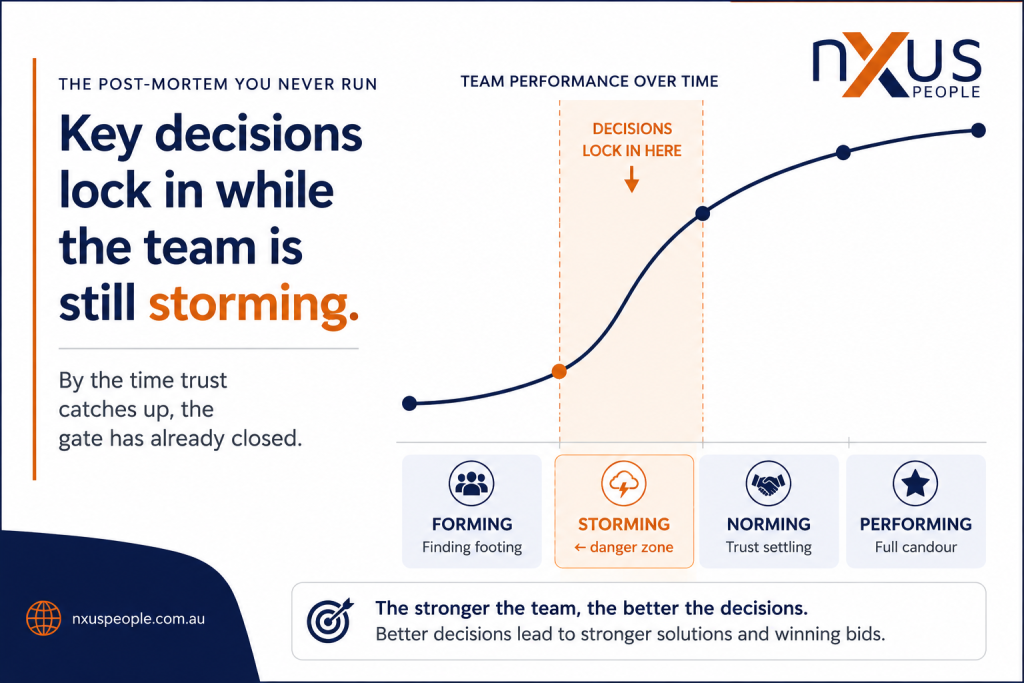
The Tuckman model is useful here: forming, storming, norming, performing. The model isn’t perfect, but the pattern is real. New teams reliably pass through a period of low trust, competing styles and unspoken assumptions before they perform.
The challenge is that Blue Review doesn’t wait for the team to get there.
In most bids we see, Blue Review lands somewhere between storming and early norming. The pressure is high, the stakes are visible, and the dominant voices are louder than the diverse ones. The solution that gets agreed is the one that creates the least visible friction. Not the one the team would land on six weeks later, when trust has had time to catch up.
That gap is the bid risk that nobody costs.
What we see go wrong
The pattern is consistent across the bid teams we work with.
The kickoff is run as a logistics meeting. Schedule, resource plan, document tree, colour review dates. The team leaves with a plan and no shared sense of how it will work together.
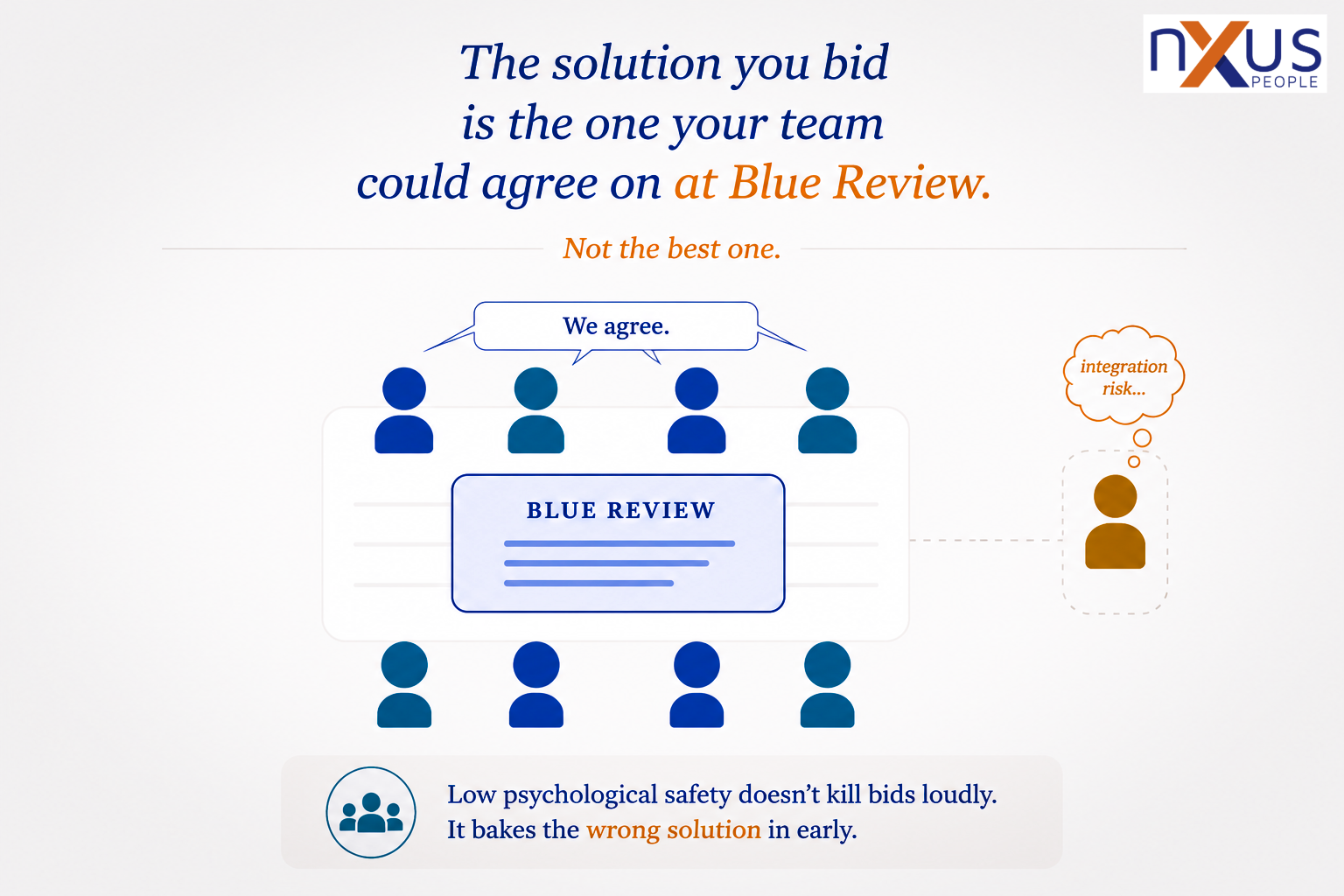
The technical solution gets locked early, often in the first two weeks, by the two or three people who feel most confident speaking. The rest of the team inherits a solution they did not help shape and quietly carries reservations they never raise.
The partner relationships are treated as commercial, not human. The teaming agreement is negotiated. The working norms between the people who will actually write the bid are not.
And the first real disagreement is treated as a problem to manage rather than a signal to act on. By the time the team realises it has been agreeing too easily, Blue Review is two weeks away and there is no room to revisit the solution.
None of these are failures of capability. They are failures of forming. The bid team had the talent to land a better solution. It did not have the time, the trust or the norms to surface it.
The hidden genius problem
Across the bid teams we have worked with, the same pattern shows up. The person who first saw the integration issue, the schedule risk or the customer signal is rarely the loudest in the room. They are often the most technically credible. And they are often the least willing to speak across a culture gap, a partner boundary or a hierarchy they have not yet tested.
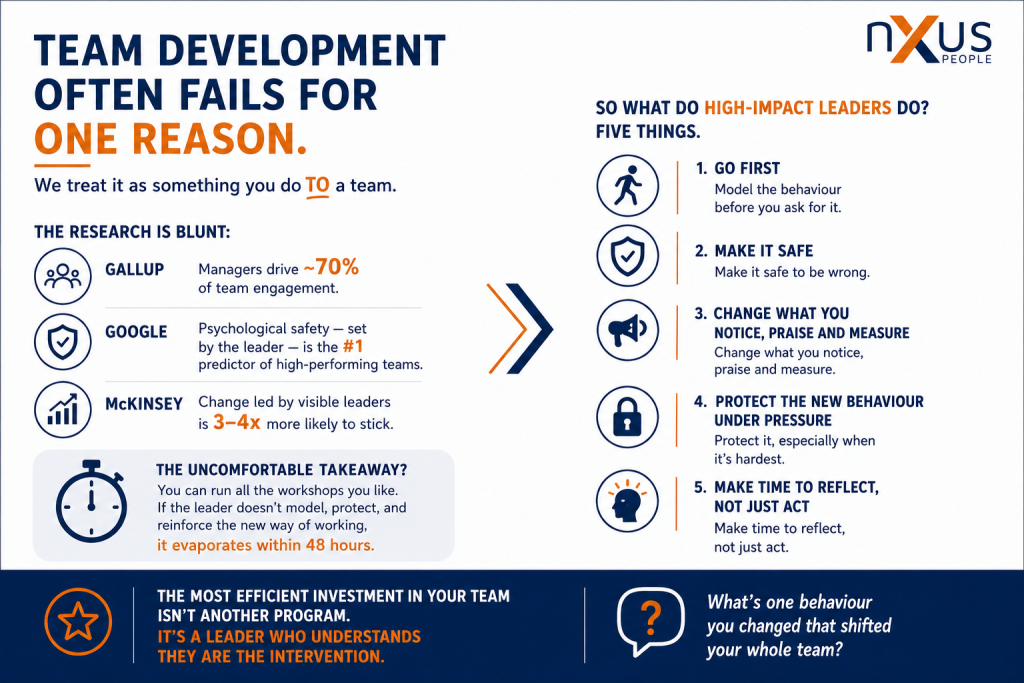
Amy Edmondson’s research on psychological safety is consistent on this point. It is not about comfort. It is about the willingness to take an interpersonal risk: to disagree with a senior person, to flag a concern, to challenge an assumption that everyone seems to have accepted.
Without that, the bid solution drifts toward what is easy to agree on. Not what is right to commit to.
The pattern compounds. The senior engineer who knows the integration approach is wrong stays quiet in the kickoff. By Pink Review, the approach has been written down, costed and defended in front of the customer. Raising it now is not a technical conversation; it is a credibility conversation. So the engineer waits for someone else to raise it. Nobody does. The bid team goes to Blue Review with a solution that the most technically credible person in the room privately doubts.
The same dynamic plays out across schedule, partner roles and price. The people closest to the work are the ones with the most accurate read on the risk. They are also the ones with the most to lose by being early and wrong. In a bid team that has not built psychological safety, being early is indistinguishable from being difficult. So the most useful signals stay in private conversations until the cost of acting on them has become prohibitive.
What “ready by Blue Review” actually looks like
A bid team that is ready by Blue Review tends to share a few characteristics.
They have explicitly named how they will disagree. Not as theory, but as a working norm. The team charter is on a wall, not in a folder.
They have surfaced their different thinking styles. They understand who needs the picture, who needs the process, who needs the data and who needs the people implications. They know how to communicate across those differences without flattening them.
They have already tested a tough conversation. A small one is enough. The team has experienced a moment of friction and come out of it stronger, so when a real disagreement arrives during Pink or Red, nobody is encountering conflict in this group for the first time.
They distinguish between consensus and silence. Silence in a bid meeting is rarely agreement. It is usually politeness, fatigue or calculation. Performing teams notice this and pull on it.
They have a working relationship with the customer team, not just a transactional one. The bid team understands not only what the customer has written down, but how the customer thinks, what they are anxious about, and what they are unlikely to say out loud. That understanding does not come from the RFT. It comes from the people on the bid team who have invested time in the relationship before the procurement opened.
None of these characteristics are accidental. Each of them is the result of deliberate work, usually compressed into the first few weeks of the bid. A high-performing team does not emerge from a kickoff slide deck. It emerges from a small number of structured conversations, held early, that the team will keep referring back to for the rest of the bid.
The cost of getting it wrong
The cost of a bid team that has not reached performing by Blue Review is rarely visible at Blue Review. It shows up later, and in places the bid team does not own.
It shows up in the executive summary that nobody can quite agree on, written and rewritten in the final fortnight because the underlying solution was never genuinely shared.
It shows up in the contract negotiation, where the assumptions the bid team made under pressure turn into clauses that the delivery team will have to live with for years.
It shows up in mobilisation, when the people who were quiet during the bid finally speak up, and the program leader realises the solution they inherited was not the solution the team would have chosen.
It shows up in the first program review, when a risk that everyone privately saw in the bid room is logged as a surprise.
None of these costs are attributed back to the bid phase. By the time they appear, the bid team has dispersed. The lessons stay with individuals, not with the organisation. The next bid team forms from scratch and repeats the pattern.
This is the quiet economics of complex bids. The organisations that win consistently are not the ones with the best response templates. They are the ones whose bid teams reach performing fast enough to put their actual best thinking on the page.
A different kind of bid kickoff
Most bid kickoffs are about the win strategy, the schedule and the resource plan. Those things matter. But they are not what determines whether the bid team can put the best solution forward by Blue Review.
The investment that consistently pays back is a short, deliberate intervention early in the bid: aligning on direction and roles, building enough trust for productive disagreement, surfacing thinking-style differences, and writing a team charter the team will actually use.
It takes days, not weeks. And it makes the difference between a bid solution the bid team could agree on, and one the bid team chose to commit to.
[Heading2] Three myths that keep bid teams stuck
A few beliefs show up repeatedly in bid leadership, and each of them quietly works against the team reaching performing in time.
The first is that team formation will sort itself out under pressure. The reasoning goes that a bid is a forcing function, and that capable professionals will rise to it. They sometimes do. More often, pressure entrenches the early dynamics of the team rather than dissolving them. The patterns set in week one usually hold to Blue Review.
The second is that experience compensates for forming. Senior bid teams, the argument runs, have done this before and do not need to invest in team work. The evidence does not support this. Senior teams form faster on average, but they are also more confident in their existing habits, which means they are slower to surface the disagreements that genuinely matter on this bid. Experience is an accelerator and a blind spot at the same time.
The third is that team work is a soft investment that competes with the hard work of writing the response. In a bid where every hour counts, time spent on team formation feels indulgent. It is the opposite. The cost of a sub-optimal solution at Blue Review is measured in millions and years. The cost of two days of structured team work in week one is measured in hours. The ratio is not subtle.
At nXus People, we run targeted team sprints for bid and program teams in exactly this window. If you are about to head into a major bid, the highest-leverage place to start is rarely the response. It is the people who will write it.
How is employee engagement trending? Read this great Gallup article for more.
How should a leader frame the challenge to get the best from the team? See this nXus People article for more.