Why complex program delivery goes wrong before contract signature
Almost nobody loses complex program delivery in the delivery phase itself. The losses are baked in earlier, during planning and bid, in the conversations that did not happen.
We see four patterns repeatedly, particularly in defence procurement, where the commercial structure makes early honesty unusually difficult.
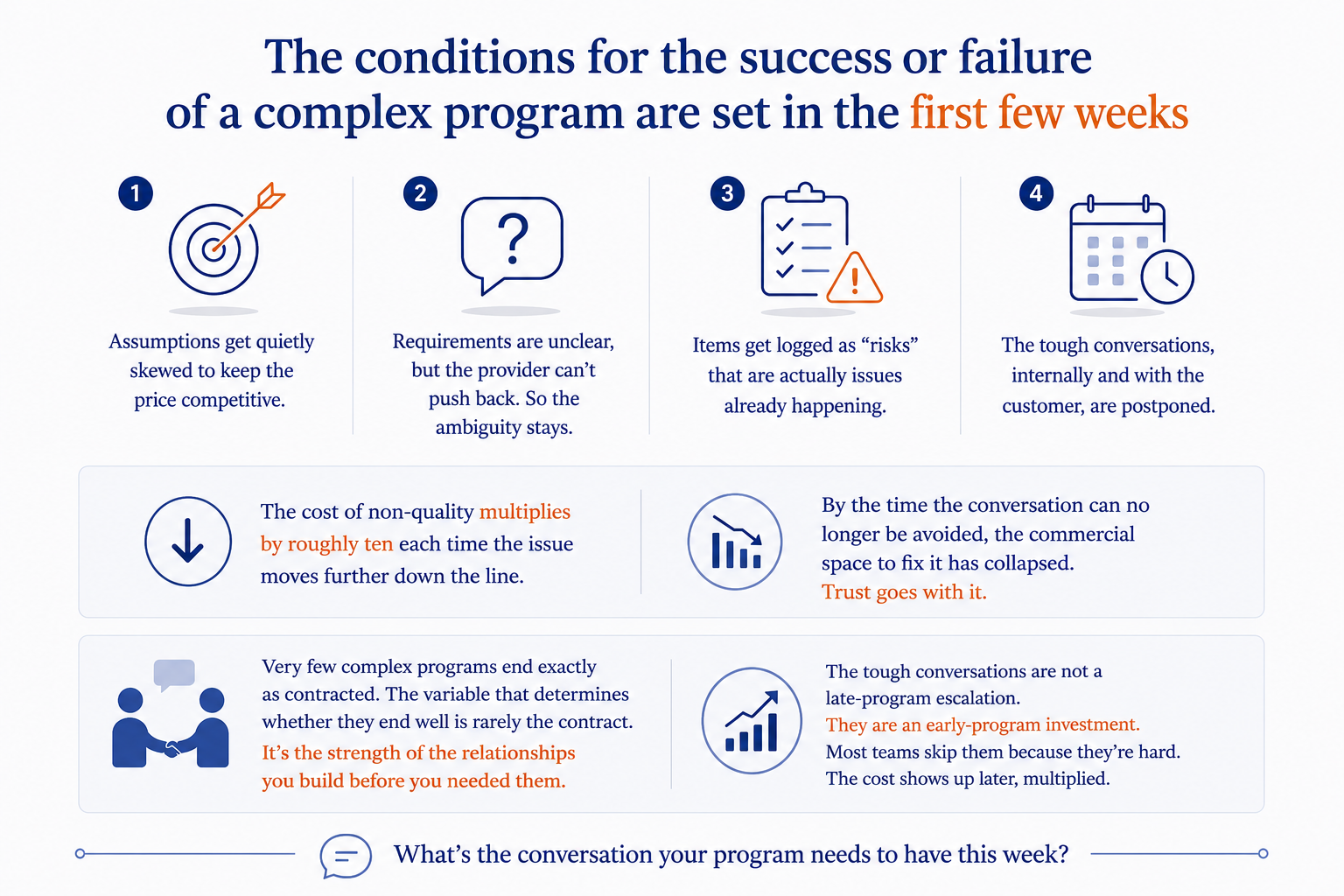
1. Assumptions skew to keep the price down
Pricing complex program delivery is an exercise in compounding assumptions. Productivity, learning curves, integration effort, partner performance, customer responsiveness. Each one, taken alone, is reasonable. Together, they almost always lean in one direction: toward the number the business needs to be competitive.
Nobody sets out to deceive. The bid team is genuinely trying to win. But the assumptions that survive review tend to be the ones that protect the price, not the ones that protect the delivery.
This is not a moral failing. It is a structural one. When the gates are designed to test commerciality and the cost of pushing back is competitive disadvantage, the system rewards optimism.
The compounding is the point. A 5% optimism in productivity, a 5% optimism in integration effort, a 5% optimism in partner ramp-up, a 5% optimism in customer responsiveness. Each is defensible in isolation. Stacked across multi-year complex program delivery, they translate into a margin gap that is mathematically certain to appear, even though no individual line could be called wrong.
The organisations that learn from this do not respond by punishing optimism. They respond by making the compounding visible. A simple discipline of asking, for each major assumption, what would have to be true for this to be wrong, and how would we know early, surfaces the directionality before the price is locked. It is a five-minute conversation in the bid phase. It is a year of recovery in delivery.
2. Requirements are unclear, but pushing back is expensive
In any serious procurement, especially in defence, the provider’s ability to challenge the customer is limited by the rules of the competition. Asking clarifying questions can signal weakness. Surfacing real ambiguity can suggest the provider has not understood the brief. Withdrawing on principle is rarely commercially survivable.
So providers absorb the ambiguity. They build in margin where they can. They interpret silently. They hope the relationship after contract signature will allow a real conversation.
It usually doesn’t. By the time real conversations are possible, the contract has been written against the unclear requirement, and the cost of resolving it sits with the party least empowered to escalate it.
There is a second-order effect that is easy to miss. When a provider absorbs ambiguity in the bid, the bid team learns that ambiguity is something the organisation handles by absorbing it. That habit travels into the delivery team. A pattern that started as a rational response to procurement rules becomes a cultural default. The same team that could not push back on the customer in the bid will not push back on the customer in delivery either.
The alternative is not to confront the customer in the bid room. It is to build the kind of relationship, before and during the procurement, in which clarifying questions are read as professional rigour rather than weakness. That is a relationship investment, not a clause negotiation. The providers who consistently win complex programs in defence are usually the ones who have done that investment quietly, over years, before the RFT was ever issued.
3. Risks that were already issues
Open any program risk register six months in. There is a category of entry that appears in almost every one: items rated as “risks” that are, in plain terms, issues that have already occurred.
The schedule slippage that is already happening. The integration approach that is already failing. The partner performance that is already off track. Logged as risks, with mitigation plans dated for future quarters.
This is not dishonesty. It is a recognised cognitive pattern in pressured environments. Naming something an issue forces a conversation. Naming it a risk defers one. Under pressure, deferral wins.
The cost is that the program governance is reading a register that does not match reality. Decisions are made on a picture that is months out of date.
4. The tough conversations get postponed
The honeymoon period after a contract is signed is the worst possible time to delay difficult conversations, and the easiest time to delay them. Goodwill is high. Working relationships are new. There is a shared incentive to make it work.
So the call that the requirement was unclear doesn’t get made. The flag that the assumed productivity is optimistic doesn’t get raised. The disagreement about scope sits unspoken in the room.
And then it compounds.
The cascade nobody owns
The four patterns above do not sit in isolation. They feed each other in a way that is easier to see in hindsight than in the moment.
The optimistic assumption makes the price competitive. The competitive price makes pushing back on unclear requirements harder, because there is less commercial room to absorb a re-scope. The unclear requirement gets absorbed into the solution, which means the risk register inherits an issue that is not yet visible. The not-yet-visible issue gets logged as a risk to avoid forcing the conversation. The conversation does not happen, and the optimism quietly compounds.
Each link in the chain is, individually, a reasonable choice for the person making it. The bid manager protecting price, the capture lead managing customer perception, the engineer logging a risk rather than an issue, the program leader preserving honeymoon goodwill. The cascade is not driven by individual failure. It is driven by the absence of a forum in which the four patterns can be named together and addressed as a system.
In most complex program delivery we see, nobody owns the cascade. The bid manager owns price. The technical lead owns solution. The contracts team owns clauses. The program leader owns mobilisation. The cascade lives in the seams between these roles. Until somebody is explicitly accountable for it, it remains everybody’s problem and nobody’s job.
The 10x rule of non-quality
There is a heuristic in quality work that the cost of fixing a defect grows by roughly an order of magnitude every time it moves further down the line. A misunderstanding caught in requirements costs almost nothing. The same misunderstanding caught in design is ten times more expensive. Caught in production, a hundred. Caught by the customer, a thousand.
The same heuristic applies to conversations.
A scope ambiguity raised in the bid phase costs an hour of awkwardness and possibly a competitive disadvantage. The same ambiguity raised at contract negotiation costs a re-baseline. The same ambiguity raised in delivery costs a variation, a margin hit, or both. The same ambiguity raised at acceptance can cost the program.
By the time a conversation can no longer be avoided, the commercial room to resolve it has often collapsed.
The relationship is asked to do the work that the contract should have done. And trust is asked to do the work that early honesty should have done.
The customer is part of the system
There is a temptation, when describing how complex program delivery goes wrong, to treat the customer as an external force that the provider has to manage. That framing is wrong, and it is part of why complex programs go wrong.
The customer is inside the system. The procurement rules that punish clarifying questions, the gate reviews that reward price over realism, the contract clauses that allocate risk to the party least able to control it. These are not facts of nature. They are choices, made by the customer, that shape the behaviour of every provider in the market.
The best customers in complex program delivery understand this. They distinguish between procurement integrity, which they must protect, and procurement realism, which they can quietly support. They signal, in the ways they are allowed to, what they actually need versus what the document says. They reward the provider whose questions sharpen the requirement, not the provider whose silence makes the procurement easy.
Providers who win at complex program delivery consistently learn to read those signals. They do not treat the customer as an adversary to be managed. They treat the customer as a partner whose constraints are visible, whose preferences are inferable, and whose long-term interests are usually aligned with the providers who tell them the truth early.
Relationships are the only thing that survives complex program delivery intact
Almost no complex program delivery ends exactly as contracted. There will be variations. There will be re-baselines. There will be moments where one party needs the other to extend goodwill.
The variable that determines whether the program ends well is not the contract. It is the strength of the relationships built before they were needed.
Programs that end well tend to share a feature: their teams had the hard conversations early, when the cost of having them was low, the trust required was modest, and the goodwill was abundant. They treated tough conversations as an investment in the relationship, not as a threat to it.
Programs that end badly tend to share the inverse feature: their teams avoided the hard conversations until the situation forced them. By then, the conversation cost ten times what it would have, and the trust required to have it had already been spent.
The work to do before contract signature
For complex program teams, the highest-leverage early work is not the integrated master schedule. It is the team’s ability to hold tough conversations: with each other, with the customer, with partners.
That ability does not appear by itself. It requires deliberate work on trust, on psychological safety, on clarity of roles, on communication norms. It requires a team that has practised disagreeing well before the stakes were real.
At nXus People, we work with complex program teams in exactly this window, between bid award and full mobilisation, when the relationships that will carry the program are still being formed. The earlier the conversation, the cheaper it is. Every program team eventually learns this. The good ones learn it before the contract signature.
How does a defence business retain its talent? Read this nXus People post.
For a deep dive into behavoural bias in project management, check out this paper.