The Leadership Misunderstanding About Ego
This week I was talking with a client about a challenge that sits at the heart of leadership development.
They said:
“I don’t want to come across as arrogant, but I also need people to have confidence in me.”
It’s a tension many leaders experience. Whether you’re leading a team, running a business, managing a complex project or stepping into an executive role, leadership effectiveness often seems to require two qualities that can feel contradictory. On one hand, people expect confidence, conviction and decisiveness. On the other, the most respected leaders are often humble, curious and open to challenge.
The conversation led us to an interesting question: what role does ego actually play in leadership?
In organisational development and executive coaching work, the word “ego” is usually used negatively. We talk about leaders with big egos, ego-driven decisions or the damage caused when ego gets in the way of team performance. Yet the reality is more nuanced than that.
The truth is that leadership requires ego.
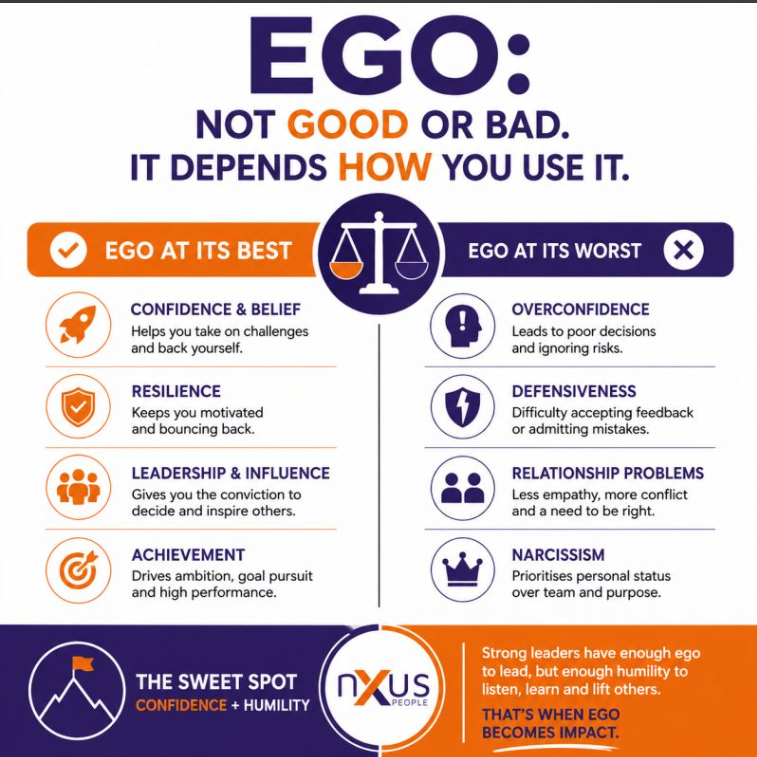
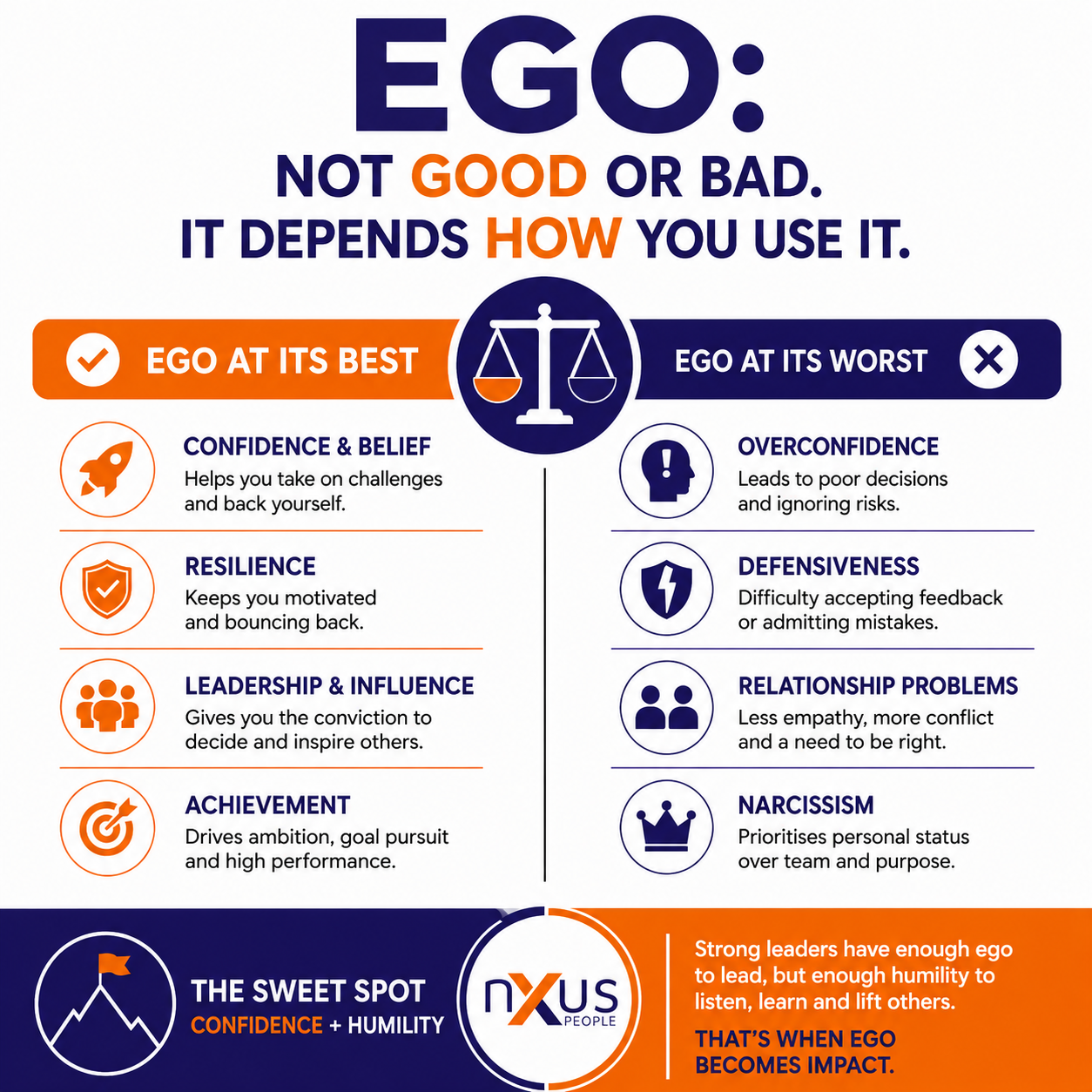
Without it, leaders would struggle to make difficult decisions, pursue ambitious goals, challenge accepted thinking or maintain confidence through uncertainty and setbacks. The issue isn’t whether leaders have an ego. The issue is whether their ego serves the mission or serves itself.
The most effective leaders I’ve worked with across government, defence, not-for-profit organisations and the private sector don’t have the biggest egos or the smallest egos. They have what I would describe as a secure ego — enough confidence to lead and enough humility to keep learning.
That’s where leadership impact lives.
Ego Isn’t the Problem
The word ego has become shorthand for everything we dislike in leadership.
When someone dismisses feedback, dominates conversations or takes credit for the work of others, we often say that their ego is getting in the way. While that may be true, it can also lead us to an unhelpful conclusion: that good leaders should somehow have less ego.
In reality, many of the qualities we admire in leaders are powered by a healthy sense of self-belief.
The leader who steps forward during a crisis. The executive who makes a difficult call with incomplete information. The manager who challenges a failing process despite resistance from others. None of these behaviours happen without confidence.
Leadership requires the belief that your actions can make a difference.
It requires the courage to make decisions that others may disagree with. It requires resilience when outcomes don’t go as planned. It requires enough conviction to move people forward when certainty isn’t available.
Without ego, leaders often become hesitant. They defer difficult decisions. They seek endless consensus. They become reluctant to challenge the status quo.
Leadership isn’t the absence of ego. Leadership is the effective management of it.
Why Ego Matters in Leadership Development
At its best, ego provides the foundation for leadership effectiveness.
A healthy ego helps leaders back themselves when circumstances are uncertain. It enables them to pursue ambitious goals and remain committed when progress is slow. It allows them to absorb setbacks without becoming paralysed by self-doubt.
We see healthy ego at work when leaders demonstrate confidence without arrogance.
They are willing to make decisions but don’t assume they have all the answers. They believe in their own capability while recognising the value that others bring. They project confidence without needing to dominate.
Healthy ego also fuels resilience.
Every leader experiences criticism, failure and disappointment. Some initiatives fail. Some decisions prove incorrect. Some stakeholders remain unconvinced despite our best efforts.
Leaders with a secure sense of self can learn from these experiences without being defined by them. They don’t interpret every setback as a personal attack. They adapt, learn and move forward.
In many respects, a healthy ego provides the psychological foundation for leadership capability.
When Confidence Becomes a Liability
The challenge is that the strengths associated with ego can quickly become weaknesses when left unchecked.
Confidence can become overconfidence.
Conviction can become stubbornness.
Ambition can become self-interest.
Most leadership derailment doesn’t happen because people lack confidence. It happens because confidence becomes disconnected from self-awareness.
We’ve all encountered leaders who stop listening because they become convinced they are right. Leaders who surround themselves with people who agree with them. Leaders who react defensively when challenged.
These behaviours rarely emerge overnight.
They often develop gradually as success reinforces a leader’s belief in their own judgement.
The danger is that success can create blind spots.
Past success can convince leaders that they don’t need feedback. Experience can become a substitute for curiosity. Confidence can become certainty.
And certainty is often where leadership problems begin.
The moment leaders stop questioning themselves is often the moment their effectiveness starts to decline.
The Question Isn’t Ego or Humility
Leadership discussions often position ego and humility as opposites.
The assumption is that leaders must choose between confidence and humility.
The best leaders understand that this is a false choice.
They recognise that confidence and humility are not competing qualities. They are complementary ones.
Confidence allows leaders to act.
Humility allows leaders to learn.
Confidence helps leaders make decisions.
Humility helps leaders improve those decisions.
Confidence enables leadership.
Humility sustains it.
The leaders who create the greatest impact are rarely those who possess only one of these qualities. Instead, they develop the capacity to hold both simultaneously.
They can advocate strongly for a position while remaining genuinely open to alternative viewpoints.
They can communicate conviction without becoming defensive.
They can lead decisively without believing they are infallible.
This combination is surprisingly rare.
Secure Ego Versus Insecure Ego
The more useful distinction isn’t ego versus humility.
It’s secure ego versus insecure ego.
Leaders with insecure egos often appear confident on the surface, but much of their behaviour is driven by a need to protect their identity.
They need to be right.
They need recognition.
They need validation.
They need others to see them as competent, capable and successful.
Because their sense of self feels vulnerable, feedback becomes threatening. Disagreement feels personal. Mistakes become something to hide rather than learn from.
In contrast, leaders with secure egos don’t need constant reinforcement.
They know who they are.
They understand their strengths.
They are comfortable acknowledging their weaknesses.
As a result, they are far more willing to seek feedback, admit mistakes and change their minds when new information emerges.
Their confidence comes from self-awareness rather than self-protection.
Ironically, this often makes them appear even more confident.
Leadership Development and High-Performing Teams
People don’t expect leaders to have all the answers.
What they do expect is authenticity, clarity and trustworthiness.
Research into high-performing teams consistently highlights the importance of psychological safety — environments where people feel comfortable raising concerns, sharing ideas and challenging assumptions.
Leaders play a critical role in creating those conditions.
When leaders become defensive or overly attached to being right, people quickly learn that speaking up carries risk.
They begin withholding information.
They avoid difficult conversations.
They tell leaders what they think they want to hear.
The quality of decision-making deteriorates.
Conversely, leaders who combine confidence with humility create space for others to contribute.
They signal that disagreement is acceptable.
They encourage challenge.
They model learning.
The result is not weaker leadership.
It’s stronger leadership supported by better information and greater trust.
What Leadership Development Should Really Be About
The sweet spot for leadership effectiveness sits somewhere between self-doubt and arrogance.
Too little confidence and leaders struggle to act.
Too little humility and leaders stop learning.
The goal is not to eliminate ego. The goal is to ensure that ego remains in service of something larger than itself.
For many leaders, this starts with a simple question:
“Am I trying to be right, or am I trying to get it right?”
The difference matters.
One approach serves the leader’s identity.
The other serves the mission.
The most respected leaders I’ve worked with tend to share a common characteristic. They possess strong opinions, but they hold those opinions lightly.
They bring confidence to conversations without needing to dominate them.
They are willing to lead, but they are equally willing to listen.
They understand that leadership isn’t about proving how smart you are. It’s about creating the conditions for better outcomes.
The Leadership Sentence Worth Remembering
If I had to capture effective leadership in a single sentence, it would be this:
“I believe I’m right, but I might be wrong.”
That statement contains the balance that many leaders spend years trying to develop.
It reflects confidence without arrogance.
Conviction without rigidity.
Humility without hesitation.
Leaders who can genuinely adopt that mindset tend to make better decisions, build stronger relationships and create higher-performing teams.
They don’t need to diminish their confidence.
Nor do they need to inflate their importance.
They simply lead with enough confidence to act and enough humility to learn.
That’s where leadership effectiveness lives.
That’s where trust grows.
And that’s where ego becomes a force for positive impact rather than a barrier to performance.
At its best, leadership isn’t about having the biggest ego or the smallest ego.
It’s about having a secure enough ego that the focus can remain where it belongs — on the mission, the team and the outcomes that matter most.
At nXus People, we help leaders, teams and organisations strengthen leadership capability, build high-performing teams, improve organisational culture and navigate complex change. Through leadership development, executive coaching, team effectiveness programs and organisational development consulting, we help leaders find the balance between confidence, humility and impact.
Learn more about leadership development in this nXus People Article https://nxuspeople.com.au/2026/04/13/successful-leadership-development/
Follow us on LinkedIn, here. https://www.linkedin.com/company/nxus-people