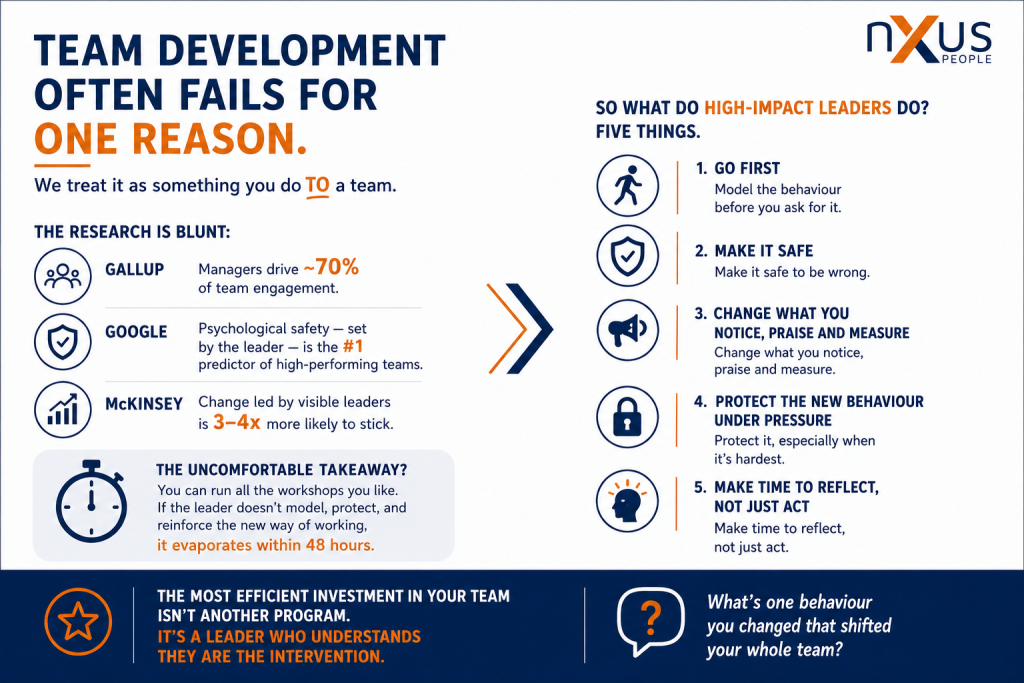
When leaders describe a program that genuinely and positively shifted how they lead, they rarely talk about content first. Strong, relevant, and coherent content scaffolding forms the essential foundation of a successful leadership development program, but most leaders describe the quality of the experience as the most critical success factor. Ask a senior leader what changed them, and they will almost never say: “the framework on slide eleven.” They will describe a moment — a conversation that cracked something open, a piece of feedback that landed differently than expected, a peer who said the thing nobody else had been willing to say.
This points to something important. Leadership development is not a knowledge transfer problem. Most experienced leaders already know more about leading than they regularly apply. The gap is rarely informational. It is behavioural, emotional, and structural — and closing it requires something more deliberate than a well-curated slide deck and a room full of capable people.
In our work helping develop leaders across industry, government, defence, for-purpose and professional services, a consistent pattern emerges. From participant feedback, the most impactful leadership development programs share a handful of key characteristics. These are not secrets, and they are not complicated. But they are often overlooked in the design phase, when the temptation is to load programs with content rather than engineer them for experience.
Leadership development grounded in real work
The most effective leadership development is grounded in real work. Generic case studies are useful for practising new competencies, but learning is deeper when the actual challenges leaders are facing right now are embedded and discussed. When skills are immediately applicable, engagement is high.
Leaders arrive at leadership development programs carrying live problems — a difficult team dynamic, a stalled project, an accountability conversation they have been avoiding for months. The best programs make room for those realities rather than setting them aside. When the learning environment treats participants’ current context as material rather than a distraction, the transfer from classroom to workplace becomes almost automatic. There is no translation step required. The learning is already attached to something real.
This is harder to design than it sounds. It requires facilitators who are comfortable yielding the agenda when something more important is happening in the room, and it requires program structures flexible enough to accommodate what participants bring rather than just what the curriculum prescribes.
Building meaningful self-awareness
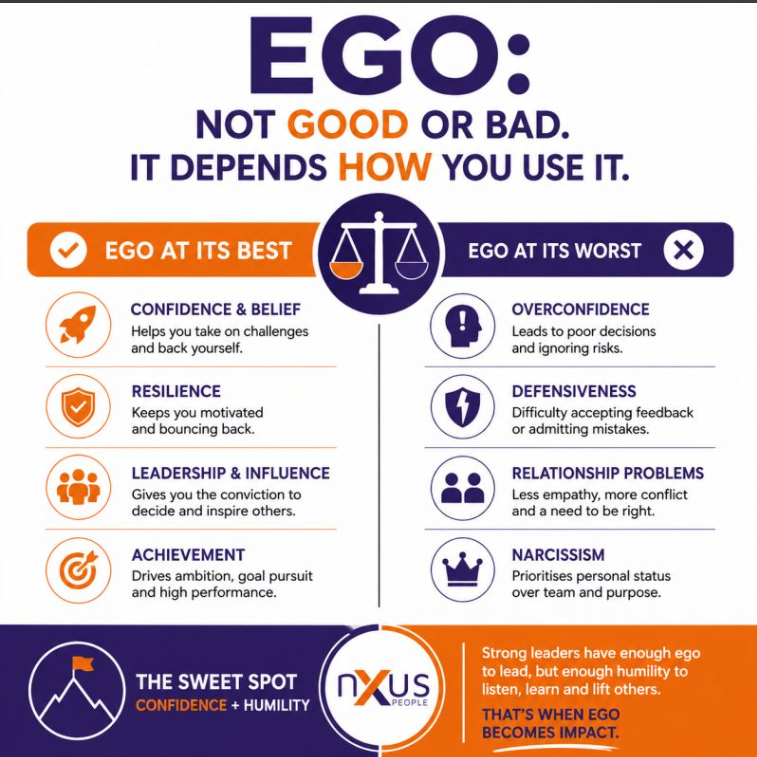
Effective leadership development builds meaningful self-awareness. Whether through tools like Whole Brain Thinking, structured 360-degree feedback, or facilitated reflection, leaders gain insight into how they show up — and how that differs from their intent.
For many leaders, this is one of the most insightful and powerful experiences on their entire development journey. The gap between who we think we are as leaders and how we are actually experienced by others is often wider than we expect. And closing that gap is where genuine development begins.
Self-awareness is not a soft outcome. It is the prerequisite for almost every other leadership behaviour worth developing. Leaders who understand their default patterns, their blind spots, and their impact on others are simply better equipped to make deliberate choices about how they lead. A leader who believes they are empowering their team — when in practice they are creating dependency through over-involvement — cannot change what they cannot see. Leadership development creates that visibility.
Opportunity to practise
Perhaps the most underinvested element of leadership development is the opportunity to practise. Frameworks such as the DESC feedback model or structured delegation models add genuine value only when they are applied, not merely understood.
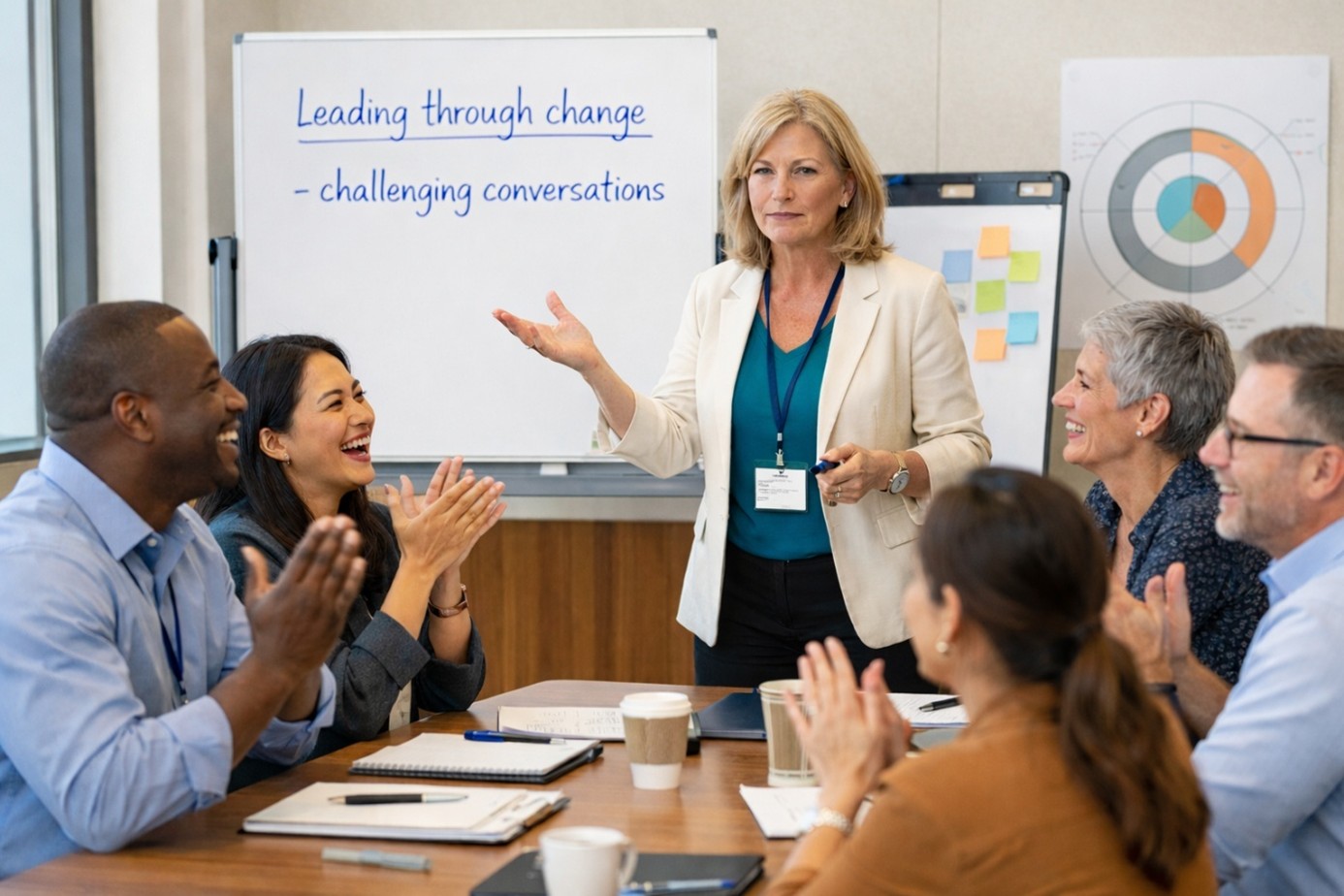
The ability to rehearse a difficult conversation, test an approach with a coach or a peer, and receive real feedback in a psychologically safe environment is what builds genuine confidence. Intellectual understanding and behavioural capability are not the same thing. A leader can articulate the principles of a good feedback conversation with precision and still freeze when the moment actually arrives. Practice — real, effortful, slightly uncomfortable practice — is what bridges that gap.
The discomfort of rehearsing a hard conversation in a room full of peers is mild compared to the cost of not having it at all. And yet leadership development programs frequently skip this step, treating capability as something that will somehow emerge on its own once the theory has been covered. It rarely does.
Facilitated by people with real experience
Leadership development works best when it is facilitated by people who have actually led. Credibility matters in ways that are difficult to replicate. Participants engage more deeply, take more risks, and are more honest when facilitators can connect theory to lived experience and adapt in real time to what is happening in the room.
There is a particular kind of trust that forms when a facilitator can say, with genuine authority: “I’ve been in that position, and here is what I learned.” It signals that the content isn’t abstract — that it has been tested under pressure, in real organisations, with real consequences. Experienced facilitators also read the room differently from those who have not led before. They notice when energy drops, when a discussion is circling something important that nobody has named yet, or when the official agenda needs to yield to a more urgent conversation. That responsiveness is itself a form of leadership modelling, and it sets the tone for the depth of learning that follows.
The power of peer learning
Some of the most valuable learning that happens inside a well-designed leadership development program happens sideways — between participants, not between participants and facilitators. Leaders consistently describe the opportunity to hear how their peers are navigating similar challenges as one of the most valuable elements of any program they attend.
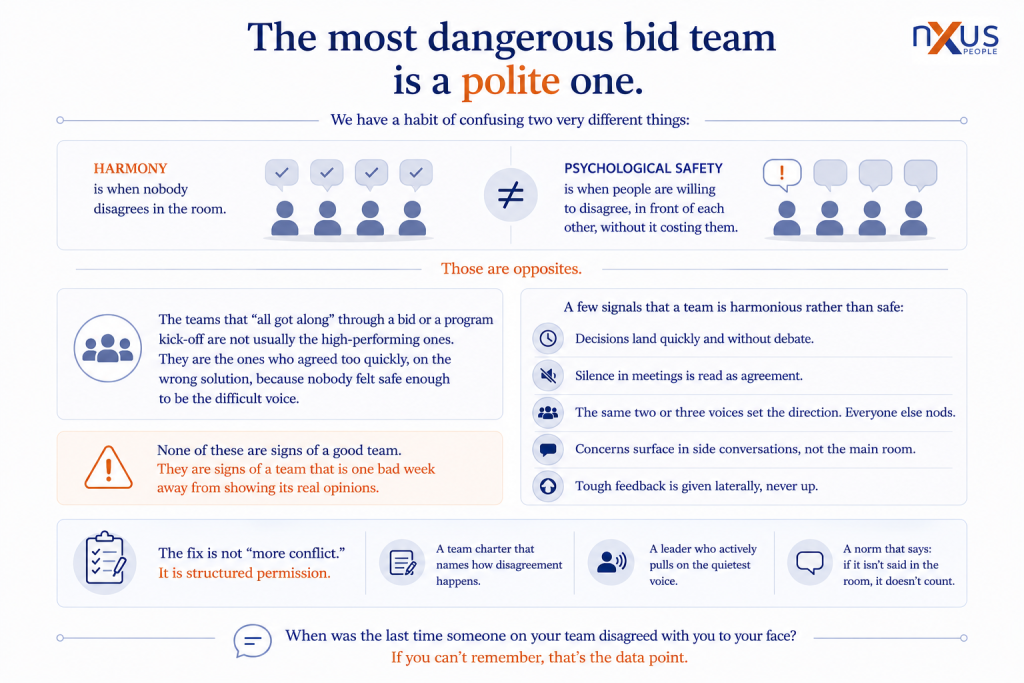
Peer learning normalises the pressure. It creates space for more honest conversation than most organisational environments allow. There is something quietly powerful about a senior leader realising that their peers — people they may privately regard as more capable or more confident than themselves — are wrestling with exactly the same tensions. That recognition reduces shame, increases candour, and creates the conditions for the kind of conversation that rarely happens in the ordinary flow of organisational life.
Well-designed leadership development does not leave peer learning to chance. It creates structured opportunities for it — small group reflection, cross-functional dialogue, facilitated case discussions — and cultivates the psychological safety that makes those opportunities genuine rather than performative. Leaders can learn as much from each other as they do from any other aspect of a well-run program, provided the conditions are right.
Extending beyond the workshop
One of the most common failure modes in leadership development is the program that ends on the final day of the workshop. There is often a surge of energy and insight at the conclusion of a well-run program. Participants leave energised, with new frameworks in mind and genuine intentions to lead differently. And then the inbox ambushes them, the calendar fills back up, and the habits that were in place before the program quietly reassert themselves.
This is not a willpower problem. It is a design problem. Leadership development experiences stick when deliberate opportunities to apply learning, reflect, and revisit key ideas are built in over time. Without reinforcement, even the best content can quickly fade into aspiration.
The neuroscience here is straightforward: memory consolidates through repetition and retrieval, and new behavioural habits form through repeated, effortful practice over time — not through a single concentrated event, however well-designed. Programs that include structured follow-through — reflection prompts, peer check-ins, short application tasks between sessions, or return sessions — produce measurably better outcomes than those that treat the final workshop day as the finish line. The finish line is where the real work begins.
This is increasingly understood in the field, and yet short, event-based programs continue to dominate the leadership development landscape, often because they are easier to sell, schedule, and measure than more extended learning journeys. The incentive structure is misaligned with the evidence. Organisations that are serious about developing their leaders design for the long arc, not just the event.
Design choices that make the difference
Ultimately, leadership development is more about shifting behaviour than it is about transferring knowledge. And behaviour changes when leaders are given the space to reflect, the tools to act differently, the opportunity to practise, and the support to sustain it.
These conditions do not arise by accident. They are the result of deliberate design choices — about what to include, what to leave out, how to sequence experiences, and how to create an environment where leaders feel safe enough to be honest and challenged enough to grow. Good leadership development design anticipates the human experience of the participant, not just the logic of the curriculum.
The programs that achieve this tend to look deceptively simple from the outside. There is no elaborate apparatus, no gimmickry, no exotic methodology. The sophistication is in what’s underneath — the careful thinking about participant experience, the sequencing of vulnerability and challenge, the way trust is built before it is tested, the integration of theory and practice so that one never gets too far ahead of the other.
The best leadership development experiences don’t feel like training. They feel like becoming a better leader in real time. And for the organisations that invest in them thoughtfully, the return is not measured in participant satisfaction scores alone — it is measured in teams that function better, decisions that are made with more clarity, and cultures that become, incrementally but unmistakably, healthier.
If you would like to know more about how nXus People creates experiences that help senior and emerging leaders become better — in real time — we’d love to hear from you.
Want insights into how well your team is set up for success? Take this 3 min quiz for instant analysis.
Want to learn more about what leadership capability really is? Check out this nXus People article.