There is no shortage of investment in leadership development. Organisations spend significantly each year on coaching, programs, assessments, and workshops — most of it focused on the individual. And that investment is rarely wasted. Better self-awareness, sharper judgment, stronger presence under pressure: these are real and valuable outcomes.
But here is the question that too few organisations ask before they invest: are we developing leaders, or are we developing leadership?
They are not the same thing. And the difference matters more than most organisations realise.
Integrated leadership development — the deliberate and concurrent development of both individual capability and collective team effectiveness — consistently outperforms either approach in isolation. Not marginally. Significantly. Understanding why requires a different way of thinking about what leadership actually is and where it actually lives.
Leadership Is a System, Not a Collection of Individuals
We tend to attribute leadership force to the people at the top. The charismatic CEO. The decisive general. The visionary founder. This is a natural cognitive shortcut — it is easier to locate leadership in a person than in the less visible dynamics between people.
But it is not accurate. And when organisations design their development investments around this assumption, they leave considerable value on the table.
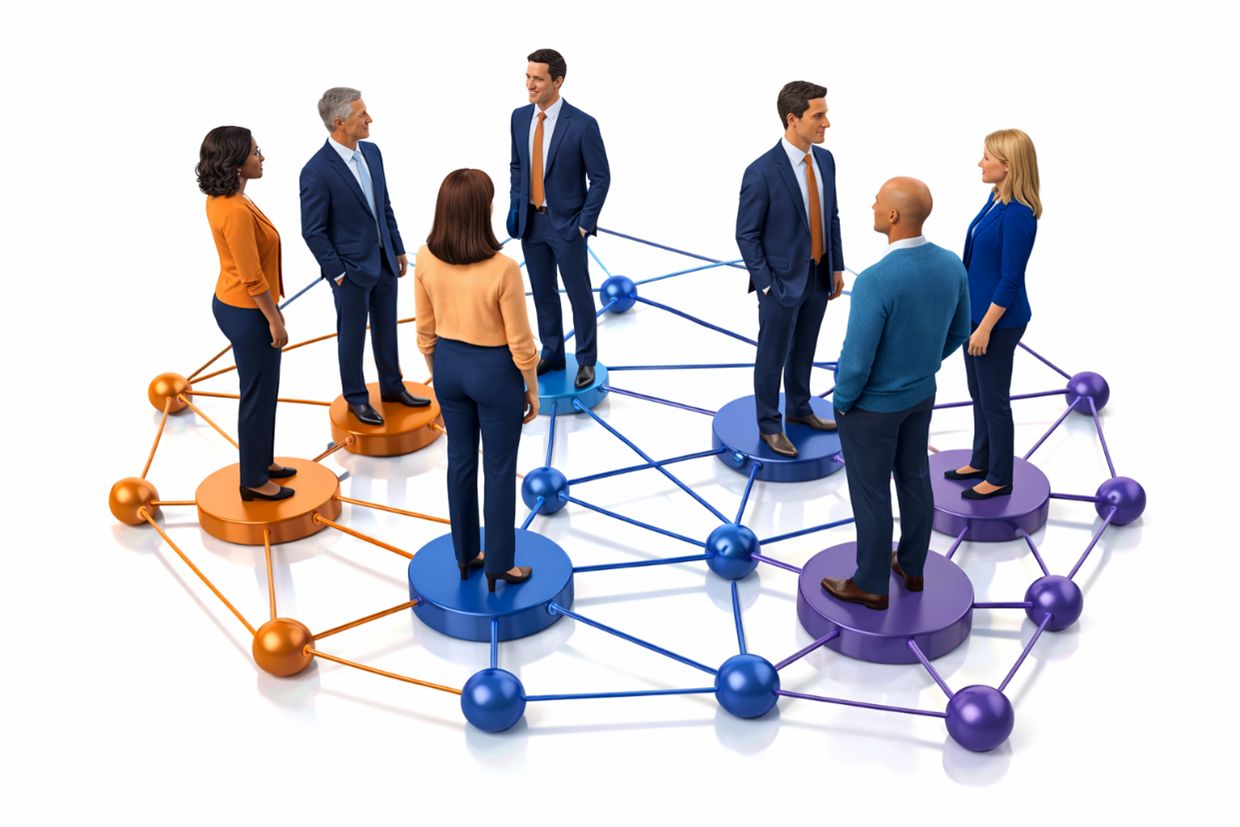
Leadership, at the organisational level, is better understood as an emergent property of a system. It does not so much sit within individuals as it arises from the way leaders connect, align, and operate together over time. The quality of that system — the trust within it, the clarity it produces, the decisions it enables — determines how much of any individual leader’s capability actually reaches the organisation.
Think of it this way. A highly capable leader operating within a dysfunctional leadership team is like a high-performance engine fitted into a vehicle with a broken transmission. The potential is real. The output is limited. The problem is not the engine.
Integrated leadership development addresses both. It builds the engine and fixes the transmission.
What Individual-Level Development Actually Develops
Individual leadership development, done well, is genuinely valuable. At its best, it builds the internal foundations that effective leadership requires: the capacity for honest self-reflection, the ability to regulate emotion and behaviour under pressure, the judgment to read situations clearly and respond proportionately, and the communication skills to engage, challenge, and inspire others.
Psychometric tools — whether HBDI, CliftonStrengths, GLWS, or others — give leaders a structured language for understanding their own thinking preferences, strengths, and wellbeing patterns. Coaching creates the space to turn that self-knowledge into changed behaviour. Leadership programs provide frameworks, challenge assumptions, and expose leaders to perspectives beyond their immediate experience.
These are meaningful investments. Leaders who have done this work are genuinely different — more considered, more aware of their impact, more capable of the kind of deliberate leadership that sustains performance over time.
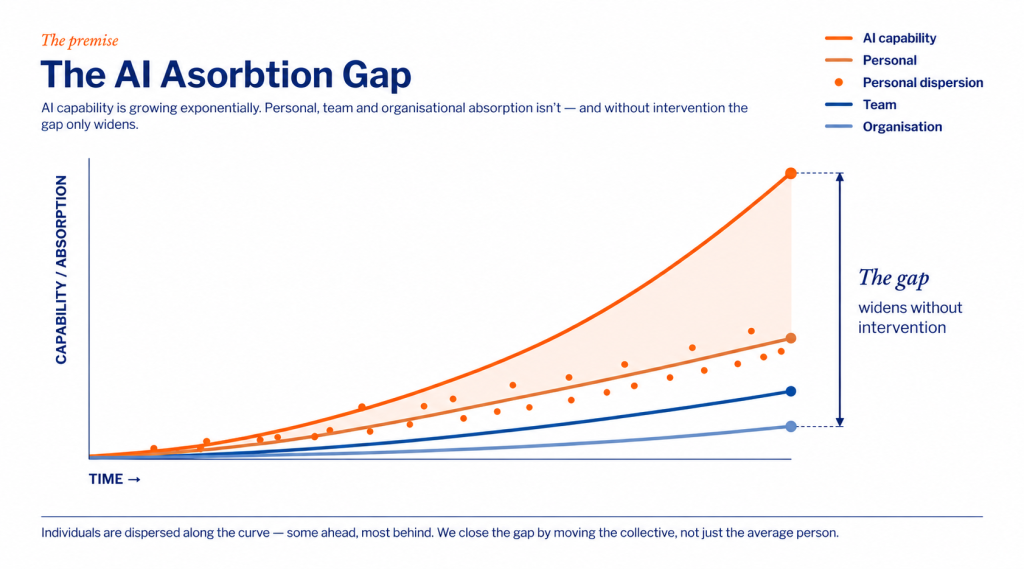
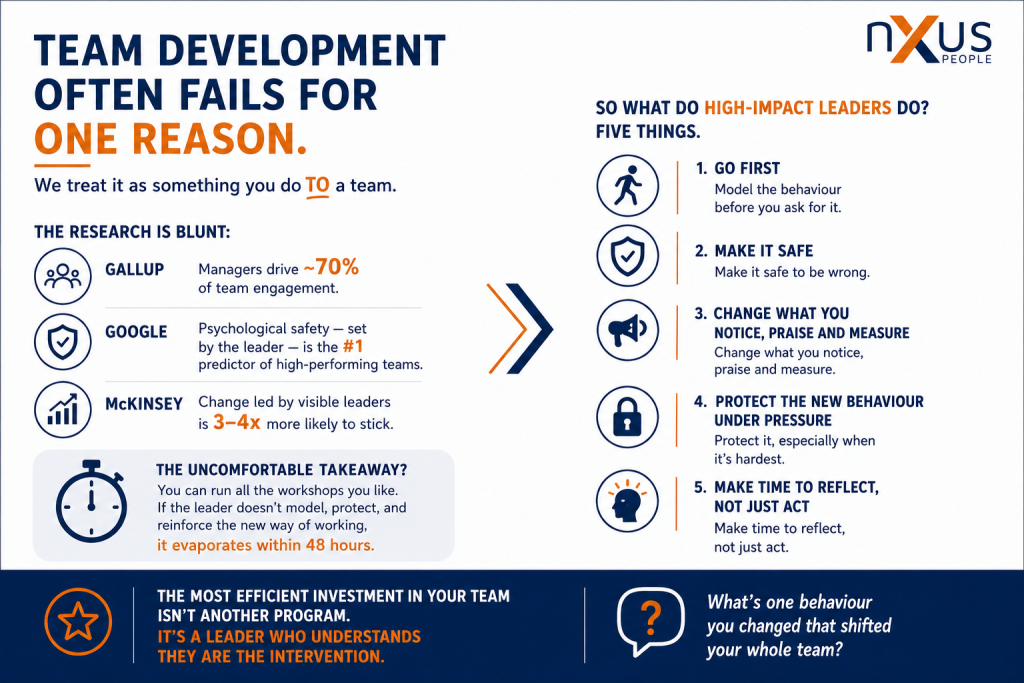
And yet. Individual development has a ceiling. When leaders return to a team system that operates on the same old dynamics — unclear accountabilities, unresolved tensions, decisions made through positional authority rather than genuine dialogue — the new capability struggles to take hold. Old patterns reassert themselves. The environment shapes the behaviour more than the development does.
This is not a failure of the individual or the program. It is a systems problem. And systems problems require systems solutions.
What Collective-Level Development Actually Develops
Leadership team effectiveness work operates at a different level of analysis. Where individual development asks how does this leader think, behave, and perform, collective development asks how does this team function as a leadership system.
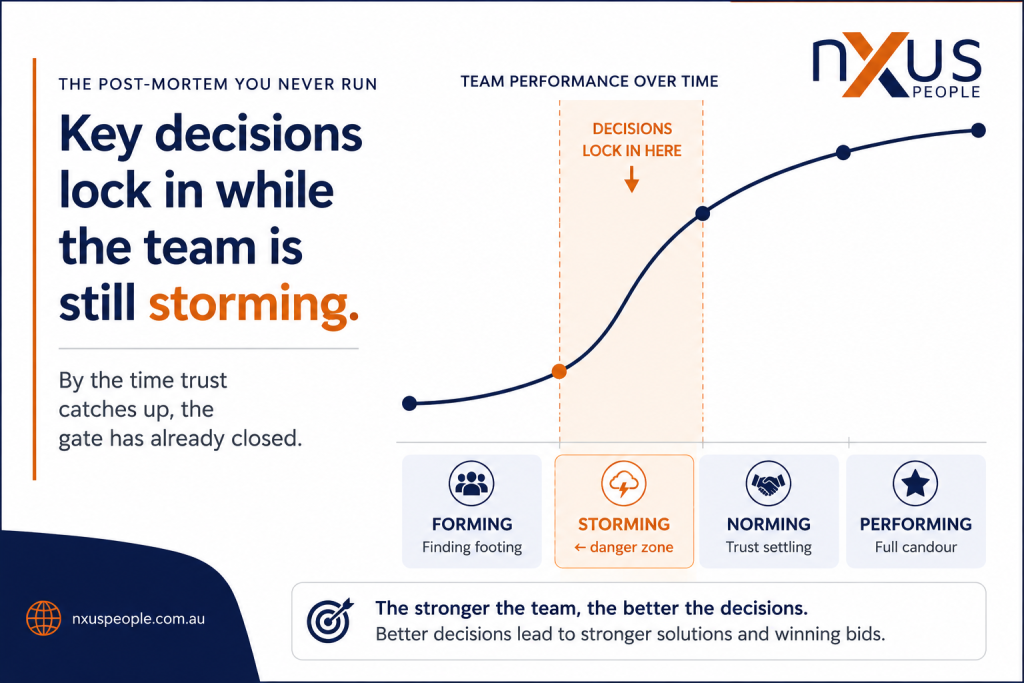
The questions are different because the dynamics are different. Teams succeed or fail based on a distinct set of conditions: the quality of trust between members, the clarity of their shared purpose and individual accountabilities, the norms that govern how they engage in conflict and make decisions, and the degree to which they hold each other genuinely accountable — not performatively, but in practice.
These conditions do not emerge automatically from putting talented individuals in the same room. In fact, the more senior and capable the individuals, the more deliberate attention the team dynamic often requires. Strong leaders have strong perspectives. They are accustomed to authority. They have reputations to protect and competing priorities to manage. Without intentional investment in how they work together, leadership teams at the senior level frequently underperform relative to the capability they contain.
Team effectiveness work — through diagnostic assessment, facilitated workshops, structured reflection, and ongoing coaching — builds these conditions deliberately. It names what is not being named. It creates the psychological safety for honest conversation about how the team is really operating. It establishes the shared agreements that allow trust to be built and maintained under pressure.
The outcome is a leadership team that functions as a genuine collective — one that makes better decisions, communicates more consistently, and creates the organisational clarity that enables everyone beneath them to perform.
The Multiplier Effect of Integration
Here is where integrated leadership development becomes more than the sum of its parts.
When individual development and collective development happen in parallel — when they are designed to reinforce rather than operate independently of each other — something qualitatively different occurs.
The self-awareness built in individual coaching becomes directly applicable in team dynamics work. A leader who has developed insight into their own behavioural patterns under pressure is a more capable participant in a team effectiveness conversation. They can name their own contribution to team dynamics honestly, rather than defaulting to attribution of problems to others.
Conversely, the work done at the team level creates conditions in which individual development can actually take hold. When the team has established genuine psychological safety — when there is real trust and honest feedback is welcomed rather than deflected — individual leaders can be more vulnerable, more experimental, and ultimately more willing to change. The system supports the individual growth rather than quietly undermining it.
The technical term for this is a multiplier effect. The practical reality is that integrated leadership development delivers returns that neither stream alone can produce.
Why the Purpose Is Integration, Not Balance
It is tempting to frame this as a balance — some development for the individual, some for the team, split proportionately. That framing misses the point.
The goal is not balance. It is integration.
Balance implies that individual and collective development are separate activities, managed to an appropriate ratio. Integration implies that they are designed as a coherent system, each informing and reinforcing the other, with clear lines of connection between what is being built at the individual level and what is being built at the collective level.
In practice, this means that the diagnostic insights from individual assessments feed into the team effectiveness work. It means that the themes emerging from team dynamics conversations inform the focus of individual coaching. It means that program design is not a catalogue of separate interventions but a deliberate architecture — a development system with a clear theory of change.
This is more complex to design and to deliver. It requires practitioners who can work fluidly at both levels, and who understand how the two interact. It requires clients who are willing to surface the team dynamics honestly rather than keeping development safely contained in the individual sphere, where it is less exposing.
But the return justifies the investment. Repeatedly.
The Practical Conditions That Make Integration Work
For integrated leadership development to deliver its potential, several conditions need to be in place.
The first is senior sponsorship that goes beyond endorsement. The most senior leader in the system — whether that is a CEO, a Secretary, or a divisional head — needs to be a genuine participant in the work, not simply its patron. Leadership team effectiveness work that excludes the leader at the top tends to plateau. The dynamics that most need examination are usually the ones that involve that person.
The second is a willingness to name what is real. Integrated leadership development creates value in proportion to the honesty it surfaces. Teams that engage with the work at a surface level — completing the diagnostics, attending the workshops, but avoiding the conversations that carry real risk — will see modest returns. Teams that are willing to go to the harder conversations will see transformational ones.
The third is time. Not unlimited time, but adequate time. The dynamics that limit team effectiveness have typically been established over years. Shifting them requires more than a single offsite. Sustained engagement — with space for the team to practise new ways of operating, reflect on what is and is not changing, and recalibrate — is what produces durable improvement.
The fourth is coherent design. The individual and collective streams need to be connected, not merely concurrent. This is a design challenge, and it is one that the practitioner or consultancy delivering the work needs to have genuinely solved.
What Organisations Stand to Gain
The organisations that invest in integrated leadership development — and do so with the conditions above in place — consistently report outcomes that go beyond what either individual or team development alone tends to produce.
At the individual level: leaders who are more self-aware, more deliberate, and more capable of the kind of adaptive, relationship-based leadership that complex environments demand.
At the collective level: leadership teams that operate with greater trust, make faster and better decisions, communicate with more clarity and consistency, and hold themselves and each other accountable in ways that build rather than erode culture.
At the organisational level: the force we call leadership actually reaches the people and functions it is supposed to serve — not filtered through a dysfunctional system, not diluted by misalignment at the top, but expressed with the clarity and coherence that enables strategy to become reality.
That is what integration makes possible. And it is what development investments focused solely on the individual cannot reliably deliver, no matter how well designed they are.
If you would like to know more about how integrated leadership development and team effectiveness can elevate your team, function, or organisation’s performance, contact nXus People at contact@nxuspeople.com.au.
How is your team set up for success? Take this three-minute quiz to find out.
Learn about the connection between leadership and wellbeing here