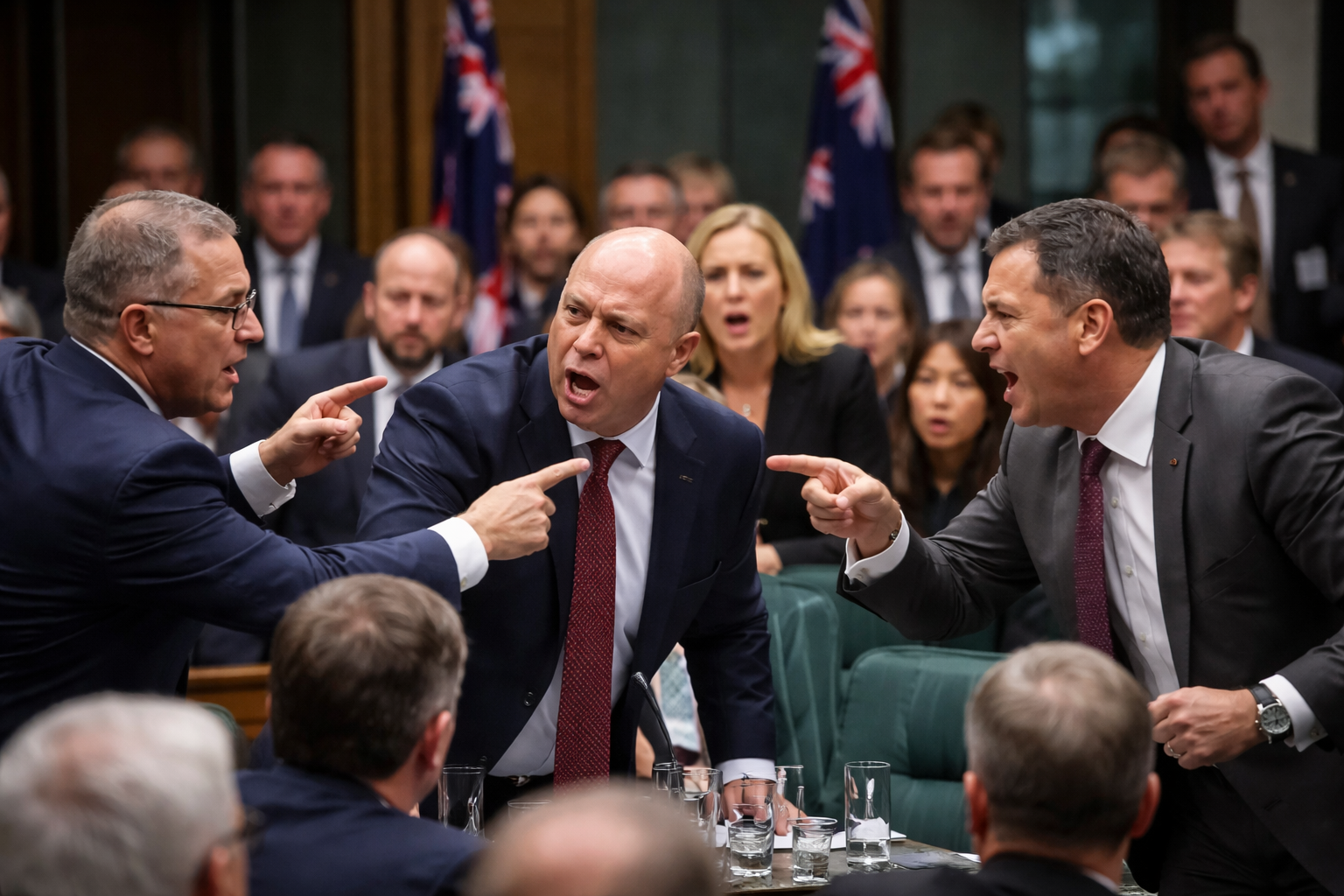
It is a salient example that helps us understand why trust in politics — of all colours — is waning. But to treat this as a political problem alone would be to miss the deeper and more important point. What we are watching play out in parliaments, boardrooms and public life more broadly is a crisis of trust in leadership — and the mechanisms driving it are neither new nor uniquely political.
Public trust in leaders, in politics and elsewhere, is vital. It is the invisible infrastructure on which organisations, institutions and democracies function. Without it, policies struggle to land, strategies fail to mobilise people, and authority becomes coercive rather than earned. Yet trust is difficult to sustain when leaders’ actions appear inconsistent, transactional and self-interested. When the gap between what leaders say and what they do widens — or when private ambition visibly overrides stated purpose — that trust erodes, often faster than it was built.
This is not a new observation. But it feels particularly acute right now. And to understand why, it helps to have a framework.
Introducing the Trust Equation
To explore trust in leadership more precisely, we can use the Trust Equation — a model we apply regularly in our work with senior leaders and teams. This useful lens was first introduced in 2000 by Maister, Green and Galford in their landmark book, The Trusted Advisor.
The equation is elegant in its simplicity:
Trust = (Credibility + Reliability + Intimacy) ÷ Self-Orientation
Each of the four variables shapes how trust is perceived, built and — critically — lost. And while the model was originally developed for professional advisory relationships, it translates with striking accuracy to leadership in public life. It gives us a language for something people often feel intuitively but struggle to articulate: why a particular leader or institution no longer feels trustworthy, even when they cannot point to a single defining betrayal.
Let’s unpack each element.
Credibility
Credibility is the foundation of trust in leadership. It encompasses both expertise and integrity — whether a leader actually knows what they are talking about, and whether they are honest about what they do and don’t know.
Many politicians enter Parliament with strong professional backgrounds: law, economics, defence, medicine, business. They bring genuine real-world experience and expertise. In other sectors, leaders often arrive in senior roles with deep functional knowledge — finance, engineering, operations — that provides a legitimate basis for authority.
But credibility in leadership is fragile. In politics, new MPs must quickly learn the complexities of Parliament — legislation, processes, negotiation, party dynamics — while operating under constant public scrutiny and media pressure. What they say in one interview may be tested against a speech they gave three years earlier, or a vote they cast under a different leader with a different platform.
In organisations, the credibility challenge is often different but equally real. Technical expertise that earned someone a senior role can become less relevant as the scope of their responsibilities grows. Leaders who were excellent operators can struggle to make the transition to strategic thinkers. And credibility, once lost — through a poorly managed crisis, an overconfident prediction that didn’t land, or a values inconsistency that becomes public — is extraordinarily hard to rebuild.
Visible factional manoeuvring in politics compounds this challenge. When a politician’s stated position on a policy question shifts noticeably following internal party dynamics rather than new evidence, positions begin to appear politically driven rather than principle-driven. The same dynamic occurs in organisations when leaders are seen to change their tune based on who is in the room, or which way the wind is blowing from the executive.
Credibility, therefore, is not just about qualifications or track record. It is about demonstrating competence within the system while remaining steadfast in clear values — even when that steadfastness is costly.
Reliability
Reliability is about consistency over time. It is the cumulative evidence that a leader does what they say they will do. In complex and volatile environments, reliability does not demand perfection. What it demands is steadiness, clear direction, consistent signals, and follow-through. People can forgive leaders for changing course when circumstances change. What they find much harder to forgive is unexplained reversal, or the sense that commitments made in one context are quietly abandoned in another.
Trust in leadership depends heavily on reliability because it is what makes a leader predictable — and predictability, in its best form, is deeply reassuring. When people know what a leader stands for and what they are likely to do in a given situation, they can orient themselves around that. When leadership behaviour is erratic or contingent, people spend energy managing uncertainty rather than doing their best work.
Leadership spills, reshuffles and internal contests are vivid illustrations of reliability failure at a systemic level. They create a sense of instability that is difficult to counter with even the most polished communications strategy. The narrative of churn takes hold. Even effective policy delivery — even genuine achievement — can be overshadowed by the perception that the system is consuming itself.
In organisational life, the equivalent is the leader who commissions a strategy review and then does not act on it, or who signals a priority in an all-hands and quietly deprioritises it three months later. Trust in leadership — and in the organisation’s direction — erodes not through any single dramatic failure but through the steady accumulation of small reliability gaps.
Intimacy
Intimacy is perhaps the most misunderstood element of the Trust Equation. It is not about friendship or personal disclosure. In this context, intimacy means knowability — the degree to which those being led have a genuine sense of who the leader is, what they stand for, and what they are likely to do.
Do I understand what this person believes? Do I have a sense of their character? Are they predictable in their values, not just in their messaging? Can I trust them with something sensitive, knowing they won’t weaponise it?
Intimacy in trust in leadership is about the sense that there is a real person behind the role — someone with genuine convictions, who has thought carefully about what they are doing and why, and whose behaviour is shaped by something more durable than the immediate political or organisational environment.
This is precisely where modern political communication often falls short. The professionalism of contemporary political messaging — the media training, the message discipline, the carefully calibrated announcements — can actually work against intimacy. When every interaction feels managed, when answers are consistently pivoted back to talking points, when vulnerability or uncertainty is never acknowledged, leaders begin to feel like operators within a system rather than individuals with clearly anchored convictions.
The same failure mode appears in organisational leadership. Leaders who communicate only through formal channels, who never acknowledge doubt or difficulty, who seem to have an answer for everything but listen to nothing — these leaders can achieve authority but rarely achieve the kind of trust in leadership that sustains followership through genuine adversity.
When leaders do demonstrate intimacy — when they speak honestly about a difficult decision, acknowledge the limits of their knowledge, or show consistent behaviour across public and private settings — trust builds in ways that are disproportionately powerful. People remember it precisely because it is so rare.
Self-Orientation — The Denominator
This is where trust rises or falls most dramatically.
Self-orientation is the degree to which a leader’s behaviour appears to be motivated primarily by their own interests — preserving position, securing advancement, consolidating power, protecting reputation — rather than by the interests of those they serve.
In the Trust Equation, self-orientation sits in the denominator. This is mathematically significant. Even if credibility, reliability and intimacy are all relatively strong, a sharp increase in perceived self-orientation will sharply reduce the overall trust score. It does not need to dominate — it needs only to increase. And once people begin to suspect that a leader’s decisions are being shaped primarily by self-interest, they apply that lens retrospectively. Decisions that previously seemed reasonable begin to look different. The benefit of the doubt evaporates.
This is why high self-orientation is so destructive to trust in leadership. It does not just affect the present — it reframes the past.
In politics, the signals of high self-orientation are well-documented: leadership manoeuvres timed to personal advantage, public positions that shift alongside political winds, decisions that appear to protect the leader rather than serve the policy or the constituents. Internal negotiations that should be about ideas and values appear instead to be about career positioning and factional leverage.
But self-orientation failure is not uniquely political. Organisational leaders who protect their own function’s budget at the expense of a better outcome for the organisation, who claim credit for success while deflecting accountability for failure, who make talent decisions based on loyalty rather than capability — these behaviours carry the same cost. They signal to people throughout the organisation that the leader’s primary allegiance is to themselves.
The leadership lesson is stark: even a leader with genuine expertise, a strong track record, and good interpersonal connections can have their trust destroyed by the perception of self-serving behaviour. Because it amplifies every other weakness in the equation.
Why This Matters Beyond Politics
I want to be clear that this reflection is not partisan. Leadership contests and internal negotiations occur across parties and across democracies. They occur in corporate boardrooms, in public service agencies, in not-for-profits, and in professional firms. The dynamics that erode trust in leadership are structurally consistent across these contexts.
What politics does that other settings do not is make the Trust Equation visible in real time, in high resolution, in front of an entire population. Every leadership move is reported, analysed and debated. Every inconsistency is surfaced. Every apparent self-serving decision is catalogued. The feedback loop between leader behaviour and public perception is almost instantaneous.
This is instructive for leaders in every context — not just politicians. The behaviours that erode trust are the same. The difference is only in the visibility and the scale.
What Trusted Leaders Do Differently
The evidence from our work with senior leaders and from the broader leadership literature is consistent. Leaders who sustain genuine trust in leadership over time tend to share a number of characteristics.
They are credible without being infallible. They are clear about what they know and honest about what they don’t. They are prepared to be publicly wrong and to update their position when the evidence demands it — without simply capitulating to the loudest voice in the room.
They are reliable without being rigid. They follow through on commitments. When circumstances genuinely require a change of course, they explain it — not spin it, not bury it, but openly name what has changed and why. They understand that consistency of values matters more than consistency of outcome.
They are knowable. Not as a communications exercise, but genuinely. They have worked out what they stand for, and that foundation shapes their behaviour consistently across contexts — in formal settings and informal ones, in times of success and in times of difficulty.
And they are other-oriented. Not performatively — the self-deprecating politician or the corporate leader with a well-practised line about servant leadership does not fool anyone. Genuinely other-oriented. Their decisions, when examined closely, show a consistent pattern of putting the mission, the people they serve, or the long-term health of the institution ahead of short-term personal advantage.
This last quality — low self-orientation — is perhaps the rarest and the most powerful driver of durable trust in leadership.
A Framework for Our Times
We live in a period of heightened scepticism about institutions and the people who lead them. That scepticism is not irrational. It has been earned, in many cases, by a sustained pattern of exactly the behaviours the Trust Equation predicts will erode trust: credibility gaps, reliability failures, a sense of unknowability behind polished messaging, and the persistent appearance of self-interest driving decisions.
The answer is not more sophisticated communication. It is not better message discipline or more carefully managed public appearances. These strategies may contain the damage in the short term. They do not rebuild trust in leadership.
What rebuilds trust is sustained behavioural change — the accumulation of small, consistent acts that demonstrate competence, follow-through, genuine character, and low self-orientation. Over time, and only over time, that accumulation shifts the perception.
Today’s politics makes the Trust Equation visible in real time. Whether or not we are paying attention to the politics, the lesson is available to any leader willing to look — and to ask, honestly, how their own behaviour scores across each of its four elements.
Want insights into how well your team is set up for success? Take this 3 min quiz for instant analysis. https://nxuspeople.outgrow.us/nxuspeople-2
What is leadership capability? Read more in this nXus People article.