Polite teams ship sub-optimal solutions
There is a particular kind of bid, project or program team that looks excellent from the outside. The meetings run on time. The decisions get made. Nobody storms out. The leader feels good about the room.
These are often the teams that go on to produce the wrong answer. They look like high performing teams from the outside. They are not.
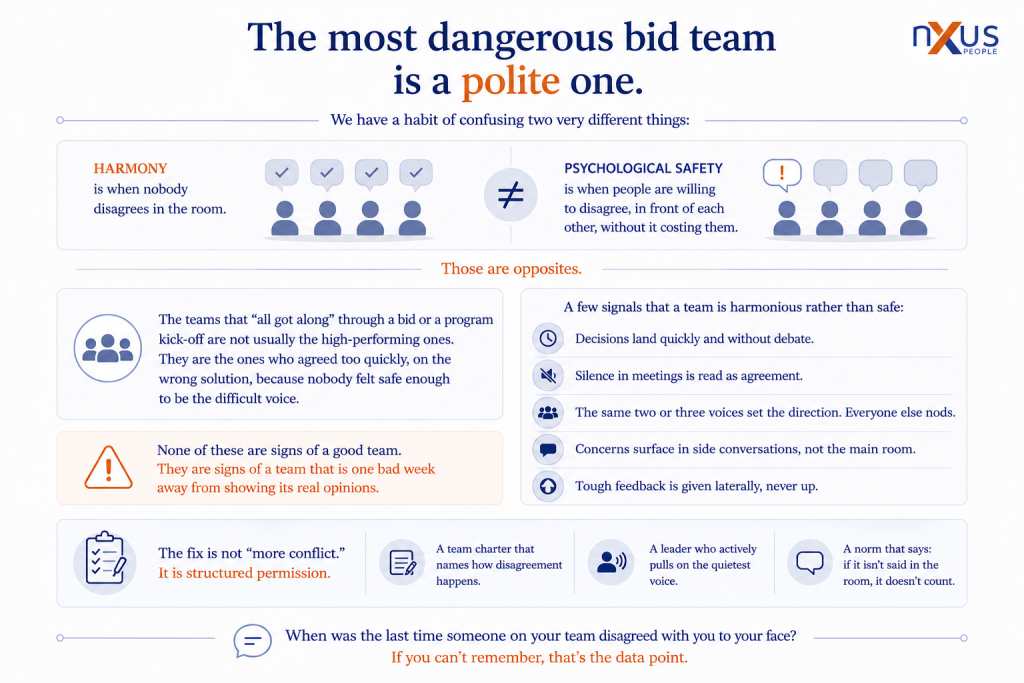
The misread of psychological safety
Psychological safety is the most over-quoted and most misunderstood concept in current team practice. It is regularly used as a synonym for niceness, for low conflict, for a comfortable working environment.
It is none of those things.
Amy Edmondson’s original definition is precise: psychological safety is the shared belief that the team is safe for interpersonal risk-taking. It is the willingness to speak up, push back, disagree, admit mistakes, and ask hard questions, without fearing that doing so will be held against you.
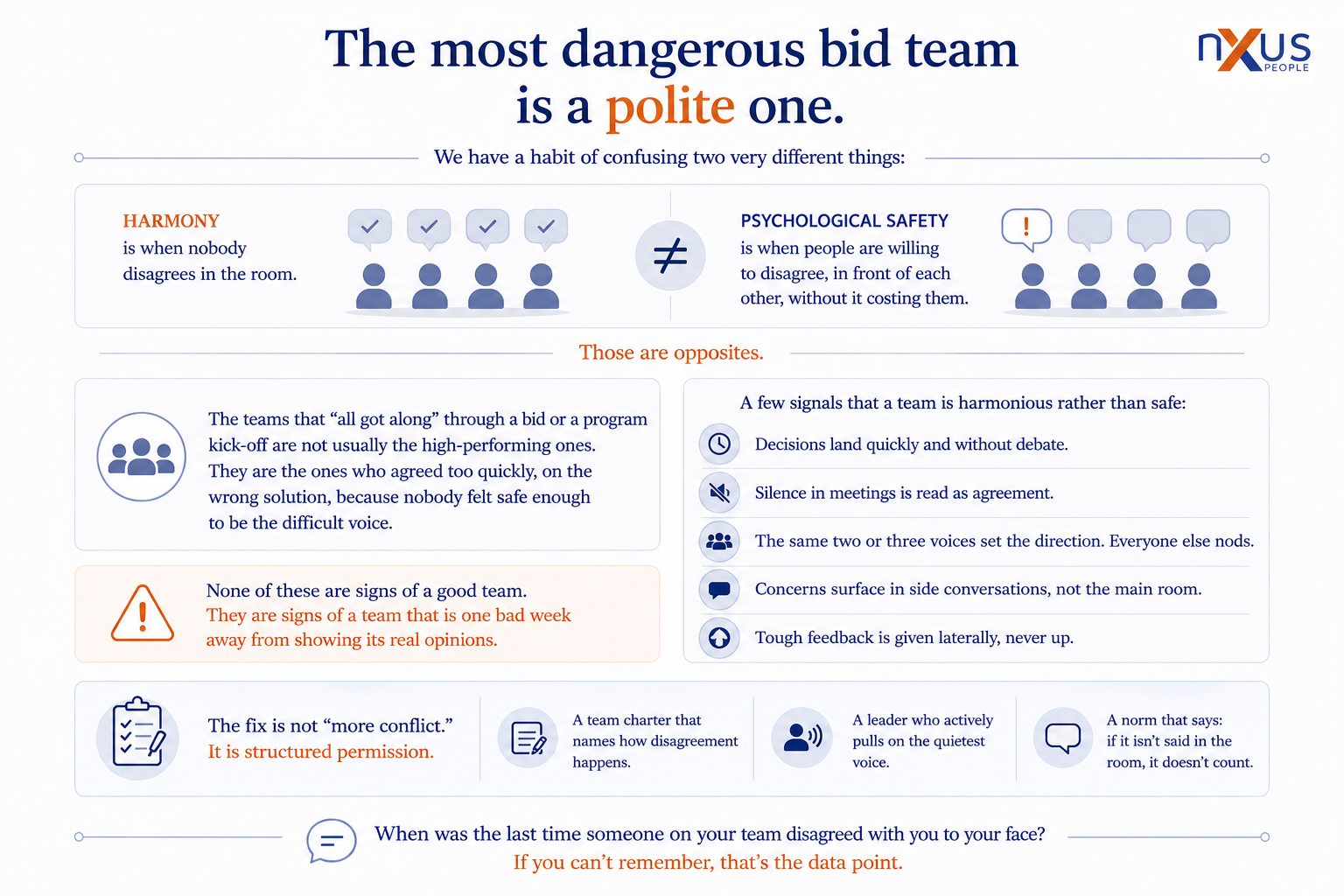
Read carefully, the definition is almost the opposite of harmony. A psychologically safe team, which is the foundation of a high performing team, is one where disagreement is more visible, not less. Where mistakes are surfaced earlier, not buried. Where the quietest voice is pulled into the conversation, not allowed to nod through it.
Comfort is what harmony produces. Truth is what a high performing team produces. They are not the same thing.
The misread matters because it changes what leaders optimise for. A leader who believes psychological safety means a comfortable team will measure success by the absence of conflict. They will reward the smooth team, not the high performing team. They will look at a meeting where everyone agreed and conclude that the team is healthy. The metric is wrong, and the team they end up with reflects it.
A leader who understands psychological safety correctly measures something different. They look for evidence that hard things are being said. They notice who is challenging whom, and whether the challenge was treated as useful or as an attack. They treat a too-smooth meeting as a diagnostic problem, not a sign of success. The team they end up with looks rougher from the outside, and produces better work.
What productive friction looks like
A high performing team operating with real safety tends to look slightly uncomfortable from the outside, in a particular way.
Decisions take longer to make in the room, because alternatives are actually tested. Once made, they stick, because everybody got their case heard. Quiet members speak. Senior members get challenged. The leader is questioned without theatrics. Disagreements happen on the substance, not the personalities. Nobody walks out of the meeting saying “well, that’s what they want, so I’ll just do it.”
A polite team has none of the qualities of a high performing team. It has the surface of agreement and the substance of avoidance.
Why polite teams break later
The cost of politeness in a bid, project or program team is almost always deferred, not avoided.
The dissenting view does not disappear. It moves into corridor conversations, into emails between two trusted colleagues, into a quiet sense among the technical specialists that the agreed approach will not survive contact with reality. The team’s actual model of the problem and its public model diverge.
The divergence holds until pressure arrives. Then the team that looked harmonious during the bid, project planning or program kickoff fractures during execution, because the disagreements were never resolved. They were only suppressed.
We see this most clearly in bid, project and program teams that commit to a solution the technical leads quietly disagreed with. The win is celebrated. The delivery team, which needed to be a high performing team from day one, is then asked to execute a plan that was never genuinely owned. The friction that was avoided in the bid room shows up, multiplied, in the first program review.
Why teams default to politeness
The pull toward politeness is not weakness. It is rational under most team conditions, including the early conditions of a high performing team that has not yet earned the right to disagree well.
If the cost of disagreeing is higher than the cost of staying quiet, people will stay quiet. That cost might be social: looking difficult, being seen as not a team player. It might be hierarchical: disagreeing with the lead, the executive, the customer. It might be cultural: working across organisations or partners with different norms about challenge.
Defence bid, project and program environments stack these costs. Multiple organisations, multiple hierarchies, customer relationships that punish visible disagreement, time pressure that rewards quick resolution. Politeness is the locally optimal strategy for the individual. It is the globally bad strategy for the team.
The work of building a high performing team is, in large part, the work of changing the cost calculation. Of making it safer to disagree well than to stay quiet.
There is a particular dynamic worth naming here, because it shows up reliably and is rarely discussed. In any team with a visible hierarchy, the cost of disagreeing with the most senior person is asymmetric. The senior person can disagree with the team and it costs them very little. A team member can disagree with the senior person and it can cost them their standing in the room, their next assignment, or quietly, the next promotion.
This asymmetry is not anybody’s fault. It is a feature of how organisations work. But it is also the reason why the senior person in the room hears agreement more often than they should. The information they receive is filtered through the cost calculation of everyone junior to them. Unless they actively dismantle that asymmetry, in small visible ways and repeatedly, they will end up running a polite team and not knowing it.
How leaders accidentally create polite teams
Most leaders do not set out to build a polite team. They build one anyway, through small habits that read as good leadership in the moment and add up to something different over time.
They reward speed of agreement. The decision was made in twenty minutes, the meeting ended on time, the team moved on. The implicit message: agreement is what we are here to produce. Disagreement is what slows us down.
They respond defensively to challenge, often without realising it. The eyebrow raise when a junior pushes back. The slight shift in tone. The quick redirect to a different topic. None of these are explicit signals, and the leader would deny any of them. The team picks them up anyway, and updates the cost calculation accordingly.
They praise people for being team players in ways that quietly conflate teamwork with agreement. The team player is the one who gets on board. The difficult one is the person who keeps raising the same point. The labels stick. The next time the difficult one has something to say, they think harder about whether to say it.
They ask for input in ways that signal the decision has already been made. “Any concerns?” at the end of a meeting where the leader has already declared a direction. The form of the question matters. A genuine invitation sounds like “what would change your mind on this?” A closing ritual sounds like “any concerns?” The team can tell which is which.
None of these habits are bad people doing bad things. They are good people doing what feels like good leadership in the moment. The cumulative effect, over months, is the opposite of a high performing team: one that has quietly stopped telling the leader anything they did not already want to hear.
Building a high performing team that disagrees well
A few things consistently shift the calculation toward a high performing team.
Naming the norm explicitly. A team charter that includes how the team disagrees, gives permission, makes it concrete and creates a reference point. “We agreed we would push back on this kind of decision” is a different conversation from “I think I should say something.”
Pulling on the quietest voice. A leader who routinely asks “what would change your mind on this?” or “who hasn’t spoken yet?” lowers the cost of disagreement for everyone in the room.
Treating silence as data. The most useful diagnostic question is not “does anyone disagree?” It is “what would have to be true for someone to disagree?”
Modelling visible disagreement at the top. Teams calibrate to what they see, not what they are told. A leader who is publicly challenged by a peer, and visibly grateful for it, teaches a faster lesson than any training.
Practising in low-stakes moments. A high performing team is not built in a crisis. Teams that have never disagreed well in small moments cannot suddenly do it in large ones. The skill is built incrementally.
The cost of a polite year
The cost of a polite team is not paid in a single moment. It is paid in the slow drift between what the team actually thinks and what the team is willing to say.
In a bid, project or program year, the cost shows up as a solution that wins or commits to the work and then breaks in delivery. The team agreed too quickly on a technical approach the engineers privately doubted. By the time they were comfortable enough to say so, the bid was committed, the customer was sold, and the conversation cost ten times what it would have in week one.
In a program year, the cost shows up as a risk register that does not match the program. The patterns are familiar from every program review: items rated green that the working level knows are red, mitigation plans that the team has lost faith in, status reports that nobody on the team would write the same way in a private conversation. The polite team is not lying. It is reporting the version of reality that feels safest to report.
In a leadership year, the cost shows up as decisions made on incomplete information. The leader thought they had the room’s best thinking. They had its safest thinking, which is a different thing. The decisions they made were rational given the information they received. The information was filtered. The leader will not see this until something forces the filter open, usually a crisis.
None of these costs appear on a quarterly review. They appear in the gap between what the team could have done and what the team did do. That gap is, in our experience, the single biggest source of underperformance in bid, project and program teams, and the clearest barrier to a high performing team emerging. It is also the most fixable.
A note to leaders
If a leader is reading this and cannot remember the last time someone on their team disagreed with them to their face, the absence is the signal. It is not that the team has no disagreements. It is that the disagreements are happening somewhere the leader cannot see them.
That is a fixable problem, and fixing it is the work of building a high performing team. But it does not fix itself.
At nXus People, the work we do with bid, project and program teams is, in large part, building the conditions under which a high performing team can disagree well. Early, when it is cheap. In the room, when it can change something. With each other, before it has to be with the customer.
Polite teams ship sub-optimal solutions. The first job of leading a high performing team is making it safe to be the difficult voice.
How does a leader find the time to develop a high performing team? Read this article to learn more
Learn from the experts in psychological safety in the HBR article.