After a bid loss, the debrief is predictable. The solution wasn’t differentiated enough. The pricing was off. The proposal didn’t land the value case. Someone’s writing could have been sharper.
What almost never makes the agenda: the team itself.
Whether they trusted each other. Whether the quiet engineer at the back of the room felt safe enough to flag the integration risk she’d spotted in week two. Whether the key decisions were made by the people with the most relevant knowledge — or by the people with the most authority in the room.
This is the post-mortem most bid teams never run. And it is, increasingly, the one that matters most.
The real driver of bid outcomes
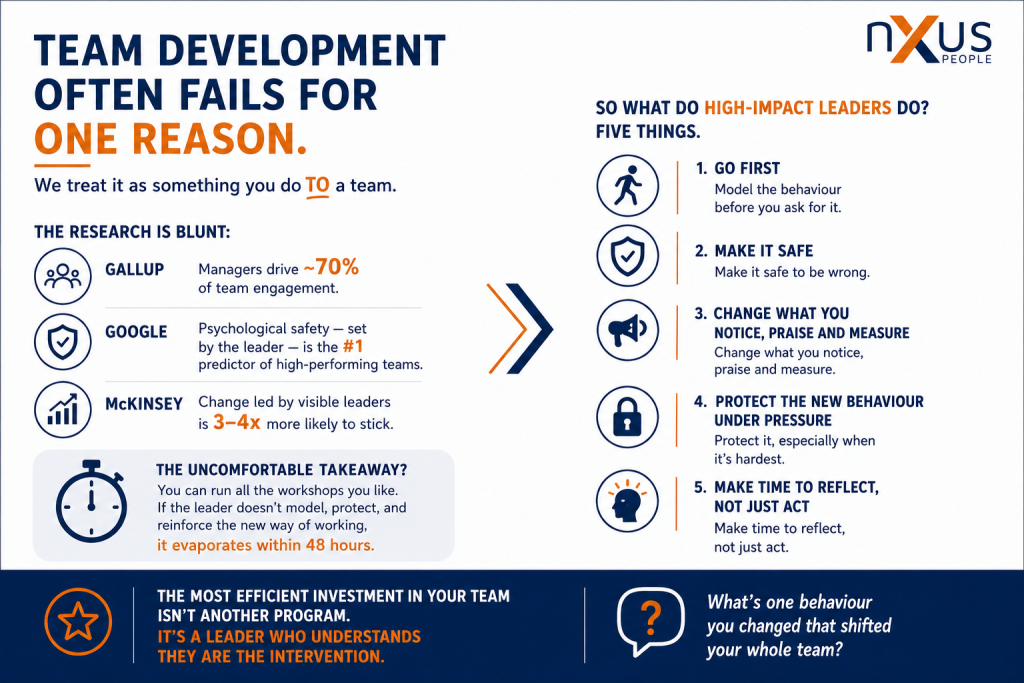
There is a growing body of evidence — from Google’s Project Aristotle, from Amy Edmondson’s work on psychological safety, from research across high-stakes team environments — that team dynamics are a primary driver of collective performance. Not a soft complement to it. Not a nice-to-have. A primary driver.
Yet in bid environments, team development is typically treated as something that happens incidentally. Teams form at kickoff, get pointed at the brief, and are expected to perform. The assumption is that a collection of capable individuals will naturally function as a high-performing team. They won’t. Not without deliberate investment in team development — and not within the compressed timelines of a typical bid cycle.
The result is a gap between what the team could produce and what it actually delivers. That gap doesn’t show up as a line item in the debrief. It shows up in the score.
The Tuckman problem: when decisions meet dynamics
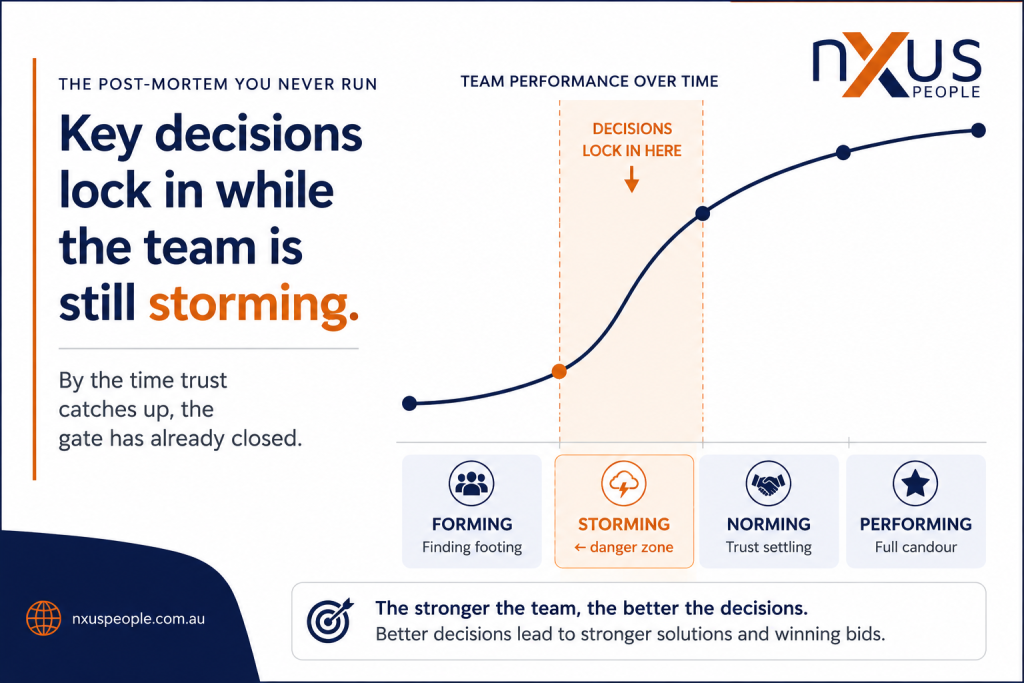
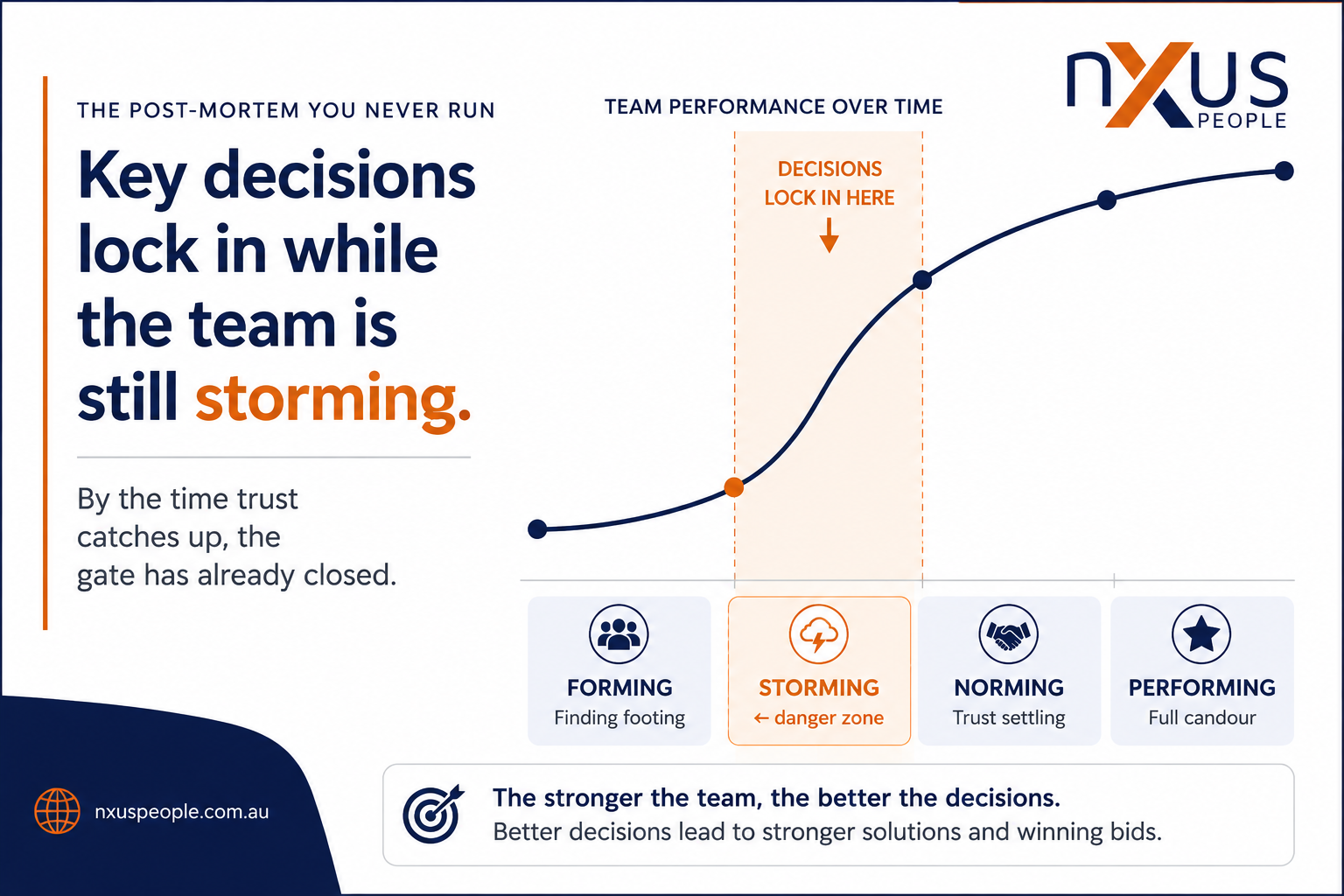
In 1965, Bruce Tuckman proposed what is now the most widely cited model of team development: Forming, Storming, Norming, Performing. The model has endured not because it is elegant, but because it is accurate. Teams move through predictable stages of development before they reach the kind of collective performance that produces genuinely excellent work.
Here is the problem for bid teams specifically: the most consequential decisions get locked in during the earliest stages of the cycle — precisely when the team is still forming and storming.
Win strategy, solution architecture, pricing philosophy, risk posture — these are not decisions that get revisited at Blue Review. They are made in the first few weeks, in workshops where people are still figuring out the room, still calibrating who speaks and who defers, still working out the unwritten rules of this particular team.
Team development at that stage is not a luxury. It is the difference between a decision-making process that surfaces the best thinking in the room and one that surfaces the thinking of whoever is most comfortable speaking first.
Most bid kickoffs invest heavily in the technical content of those early sessions — the win themes, the solution design, the preliminary staffing plan. Very few invest in the team development work that would make those sessions produce better outcomes.
The silence that kills bids
Psychological safety — the belief that one can speak up, challenge, and raise concerns without risking punishment or humiliation — is the foundation of effective team development in any high-stakes environment.
In bid teams, its absence is particularly costly because the consequences are invisible until it’s too late.
When a team lacks psychological safety, the risk does not disappear. It goes underground. The expert who sees a gap in the solution says nothing, because the last time she challenged a senior leader’s framing, the room went cold. The newcomer who has worked on a near-identical procurement before does not volunteer the lesson learned, because he hasn’t yet established enough standing to be taken seriously. The integration manager who knows the proposed timeline is optimistic nods along, because publicly disagreeing with the program director feels like a career move he’s not ready to make.
These are not dramatic failures. They are the quiet, everyday product of a team that has not done the team development work to build the trust and behavioural norms that make honest exchange possible.
The bids that hurt most are not lost to a better solution. They are lost to a team that couldn’t surface one.
The polite team is the dangerous team
There is a temptation, particularly in professional environments, to read harmony as a signal that a team is functioning well. A meeting where everyone agrees, where there are no difficult moments, where the conversation flows easily — that feels like progress.
It is often the opposite.
The most dangerous bid team is a polite one. Politeness, in a high-stakes team context, is frequently a substitute for candour — not evidence that no candour is needed. When teams are not in the habit of productive disagreement, they do not surface the things that most need to be heard. They produce the solution everyone can agree on, not the best one.
Effective team development builds the capacity for what might be called constructive provocation: the ability to challenge an idea directly, without attacking the person behind it; to raise an uncomfortable view without it becoming a referendum on someone’s competence; to disagree strongly and move forward together. This is a skill that teams develop through deliberate practice, not through proximity.
It does not emerge automatically when you put smart people in a room. It is built.
What bid team development actually looks like
Team development in a bid context is not a one-day offsite or a Myers-Briggs session followed by lunch. It is a structured, deliberate investment in the conditions that allow a group of people to perform at the level the bid demands.
Done well, it addresses three things simultaneously.
First, trust and psychological safety. Using frameworks like Edmondson’s teaming model and the SCARF model (Rock, 2008), effective team development programs create the conditions for honest exchange — not by asking people to be more open, but by building the norms, habits, and relational foundation that make openness safe.
Second, cognitive diversity and shared mental models. Bid teams are typically assembled for technical coverage, not for thinking-style balance. Tools like the HBDI (Herrmann Brain Dominance Instrument) surface the cognitive diversity already present in the team and help members understand how different thinking styles can strengthen decision-making — rather than creating friction that slows it down. This is a core element of genuine team development, not a personality-test novelty.
Third, decision-making quality under pressure. High-performing bid teams do not just make better decisions in workshop conditions. They make better decisions when the timelines compress, when the brief changes at short notice, when the program director is under pressure and the room dynamic shifts. Team development that does not prepare teams for that reality is not adequate preparation at all.
The window
There is a window in every bid cycle where team development investment pays back most. It is not after gate. It is not mid-programme when patterns have calcified and people have learned what they can and can’t say in this room.
It is the period between team formation and the first major decision point — typically the first two to four weeks of the bid cycle, when the team is assembled, the brief is being worked, and the win strategy is taking shape.
This is the moment to invest in team development. Not because it is the easiest moment — it often isn’t — but because it is the moment when the investment changes the most. A team that enters its first gate review with genuine trust, psychological safety, and a shared decision-making culture will produce better work across every subsequent stage of the programme.
A team that does not do that work will compensate in other ways: through hierarchy, through deference, through the kind of consensus that feels like alignment but is actually avoidance.
What changes when teams invest early
The outcomes of deliberate early team development in bid environments are not abstract. They are observable and measurable.
Bid teams that have done the work tend to surface technical and commercial risks earlier — when there is still time to address them rather than manage them. They produce more genuinely differentiated solutions, because the full thinking of the team has been activated rather than filtered through whoever dominates the room. They respond better to disruption — a brief amendment, a change in key personnel, a late pricing challenge — because the relational infrastructure exists to absorb the pressure without fracturing.
They also, in the author’s experience, tend to feel different to work on. Team development that builds genuine trust and safety does not just improve outcomes. It changes what the bid feels like to the people doing it — from a period of sustained pressure and managed risk to a period of genuine collaboration toward a shared goal.
That shift matters more than it might sound. People who have experienced high-quality team development in a bid context seek it out. They become the advocates inside organisations for the kind of early investment that makes the difference.
The team development investment question
The obvious objection to early bid team development is time. Bid cycles are compressed. The brief arrived late. The program director needs the win themes by Friday. There is no space. This is almost always a false economy.
The time spent on team development in the first two weeks of a bid cycle is recovered many times over in the quality of the decisions made in weeks three through twelve. Teams that trust each other move faster. They spend less time in unproductive conflict, less time managing the political dynamics that emerge when people don’t feel safe, and less time revisiting decisions that were made by the wrong people for the wrong reasons.
The question is not whether there is time for team development. The question is whether the bid can afford to skip it.
A different kind of post-mortem
The debrief most organisations need to run is not about the proposal. It is about the team.
What were the moments in this bid cycle when the right view was in the room and did not make it into the decision? Where did hierarchy substitute for expertise? Where did politeness stand in for honesty? What would the team have produced if every person in it had felt genuinely free to bring their best thinking?
These are not comfortable questions. But they are the questions that team development — done seriously, done early, done with real rigour — is designed to answer. Not after the loss, but before the gate.
The bids that hurt most are not lost to better solutions. They are lost to better-developed teams. And team development is not the soft work that happens around the edges of a bid. It is the foundation on which the bid is built.
nXus People works with organisations operating in complex, high-accountability environments — including defence primes, government contractors, and professional services firms — to build the team development capability that makes the difference in high-stakes bids. If you would like to talk about what early team investment could look like for your next bid cycle, get in touch at contact@nxuspeople.com.au.
Follow us on LinkedIn
Read more of our insights here